
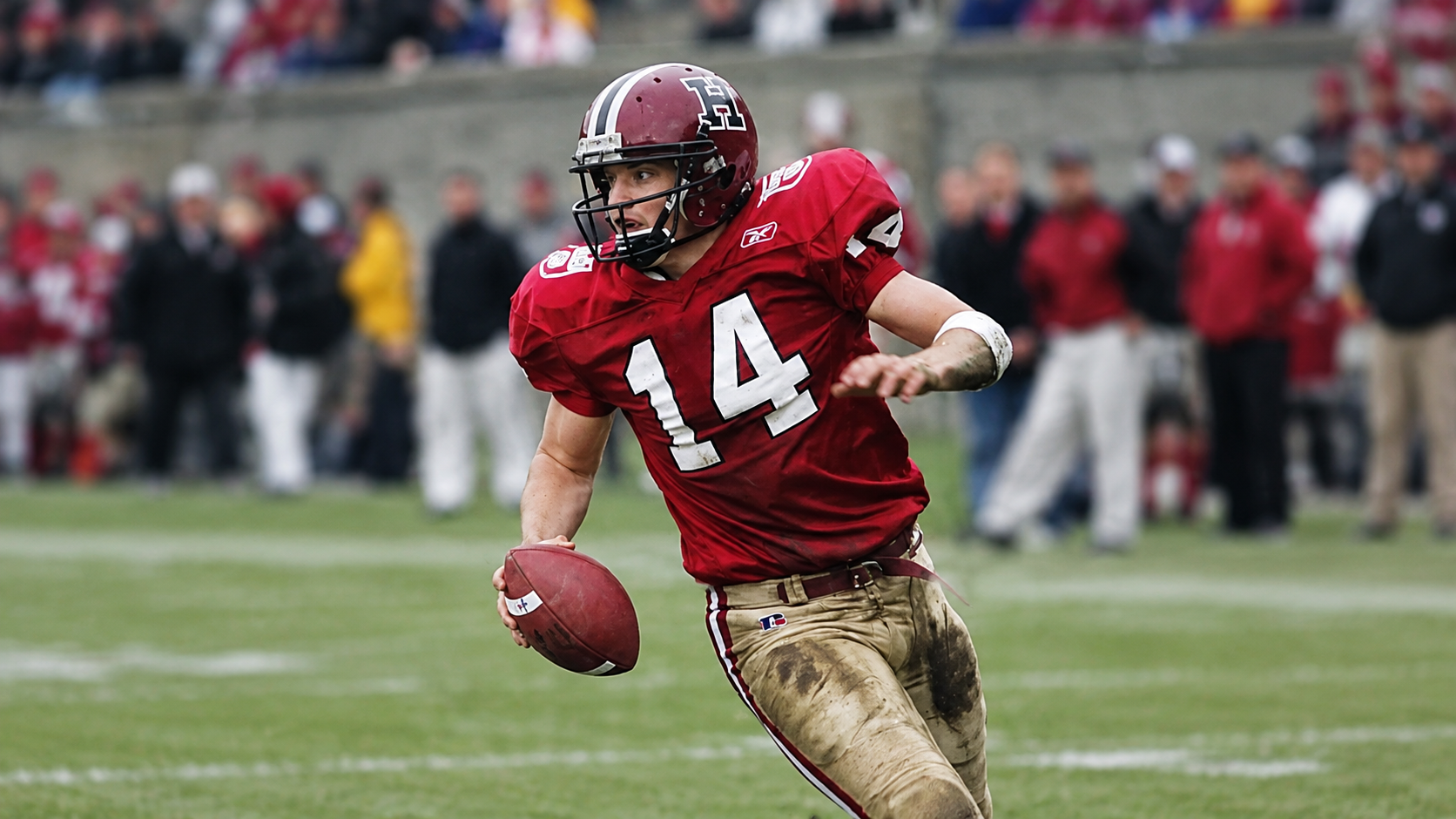
He walks to the line with a play in his head.
It was a good play in the huddle. Eleven men heard it, and ten of them are already thinking about their own piece of it: a landmark, a split, a man to block. The quarterback is the only one still thinking about all of it.
Now he looks. The safety who was sitting in the middle of the field a moment ago is drifting toward the boundary. A linebacker has crept up a step and is showing the A gap. The field corner is already bailing. None of it is dramatic, and nobody in the stands notices. But the play that was right in the huddle may not be right anymore.
The play clock is running. He has a few seconds to decide whether what he sees changes anything. If it does, he has to change it. Then he has to get ten other men to believe him, right now, over the crowd, against a defense doing everything it can to disguise what comes next.
That part of football never makes the highlight show. I have spent my coaching life on offense, much of it standing next to quarterbacks, and I've come to believe those few seconds are the most educational thing the game does.
In Notebook 004, I asked a question about universities: what do you want your football program to be? This essay is about where you can see the answer. It isn't in the mission statement or the press conference. It's at the line of scrimmage, in whether a program trusts a young man to make a decision there, and whether anyone bothered to teach him how.
Chaos, Then Slow
Ryan Fitzpatrick grew up in Gilbert, Arizona, and had barely heard of Harvard football. He'd hoped for Stanford, Northwestern or Cal. Late in high school, the only schools that came calling were Harvard and Eastern Washington. He later called it "a blessing in disguise".
What he noticed first was the speed. "At the beginning of freshman year, to me it looked like chaos on the field," he said before his senior season. "I knew the offense, but the defense moved so fast!"
Every quarterback who has ever lived has felt that. You know the plays. You've drawn them, walked them and repped them. Then the ball is snapped and eleven people who don't care about your playbook start moving at once.
Three years later, he described something else. "But the game moves so slowly for me now. Through playing experience and watching film you are able to anticipate and slow the game down a lot. You know what the defense is going to do before they do it".
Coaches talk about the game slowing down as if it happens to a player, like a growth spurt. It doesn't. It's learning. The chaos doesn't change. The player does. He learns to sort what matters from what doesn't, to recognize a picture he has seen before and to know what comes after it.
The same profile shows how that learning happened. Neil Rose, who quarterbacked Harvard before him, sat in the film room with Fitzpatrick and the other quarterbacks and explained his own decisions before the snap. That included why he wouldn't throw to a particular receiver on a given play.
An older player walking a younger one through his reasoning isn't a meeting. It's a seminar.
Fitzpatrick kept that habit for the rest of his career. Years later, starting in the NFL, he said, "I've been able to learn from the different quarterbacks I've played behind, then apply what I learned when I got on the field." He said that a lot of his improvement "came from the experience of classroom work and studying that I had while I was at Harvard".
Learn from the man ahead of you, then apply it. Plenty of graduate programs would be glad to promise as much.
The Freedom to Change the Call
Tim Murphy gave him room. By the time Fitzpatrick left Harvard, he had considerable leeway to change things at the line, to scramble and to change plays on the fly.
Harvard ran what its own magazine called one of the most sophisticated offensive sets in the country. It also played what the team called backyard ball. "Sometimes, you have to make up plays as you go," Fitzpatrick said. "You sit in the film room and design an offensive attack, and then on Saturday our biggest gains come from broken plays, making things happen".
That's the coaching choice I want to dwell on, because every staff in America makes it whether it admits it or not.
You can coach a quarterback to execute. You call the play, he runs it, and if it's wrong, that's on you. There are honest reasons to coach that way. The quarterback may be young, the system may be built tight, or the staff may simply want the decisions made upstairs. I'm not here to judge any of that.
Or you can give him the authority to change the call. The moment you do, you've taken on an obligation. You can't hand a twenty-year-old the right to check out of a play unless he understands why the play was called in the first place. He has to know what it's built to attack, what beats it and what he has instead. That isn't a list of assignments. It's a body of knowledge. It has prerequisites, it gets tested every Saturday, and it builds on itself from one year to the next.
In other words, it's a curriculum. The responsibility is what forces the teaching.
A program tells you what it believes about its players by how much it lets them decide. A quarterback who is only allowed to execute learns his job. A quarterback who is allowed to change the call has to learn the game.
The proof usually comes when things are going badly. In one game against Dartmouth, Harvard went into halftime down 21–0 and came out with a 31–21 win that kept the season unbeaten and untied. Fitzpatrick called it his favorite moment in a Crimson uniform. "I learned a lot about myself," he said. Murphy put it another way: "His poise and ability to perform under pressure was eerie. I have never seen him flustered".
A quarterback who has never been trusted to decide can't learn that kind of poise. It only comes from deciding.
What Happens in Those Seconds
Let me slow it down the way I would at a whiteboard.
The quarterback walks to the line with a call. He's asking himself three questions, roughly in this order.
First: is the play still good? Every play is built to beat certain pictures and to struggle against others. He reads the shell, whether it's one safety deep or two. He checks the leverage of the corners and the depth of the linebackers. If the picture in front of him is the one the play was built to beat, he leaves it alone. Most of the time, the best decision at the line is no decision at all, and knowing that is half the education.
Second: is he protected? He counts the box and identifies the man who can hurt him. If the protection has to change, the line has to know too. A quarterback who sees the blitz and keeps it to himself has seen nothing.
Third: who else needs to know? A route may convert against what he's looking at. The back may have to pick up a different man. Someone on the perimeter may need to change a split.
Then he has to say it, clearly enough that ten men hear it over the noise and believe it enough to commit. All of that happens in less time than it took you to read this paragraph.
The offense I gave my career to was built on that idea, that players can be taught to see and then trusted to decide.
Glenn "Tiger" Ellison went to Middletown, Ohio, in 1933 to teach English and coach football. He also earned a master's degree in counseling. For twenty-five years, he coached the way everybody in Ohio did, which meant power football. Then, in 1958, after a bad start, the story goes that he drove past a sandlot and watched kids playing pickup. There was no huddle and no plan. The quarterback scrambled, and the receivers ran to wherever the defender wasn't. He took it back to practice and called it the Lonesome Polecat. In 1965 he wrote it down in Run and Shoot Football: Offense of the Future.
What Ellison saw on that sandlot was players making decisions. The offense that grew out of it asks receivers to read coverage on the move and asks the quarterback to read it with them. None of it works unless the players have been taught to see the same thing at the same moment. You can't draw it up and hand it to them. They have to understand it.
I don't think it's an accident that an English teacher with a counseling degree built an offense on trusting young people to read and respond. He was a teacher before he was an offensive innovator, and his offense is a teacher's offense.
My first season at Hofstra was 1991. Joe Gardi had brought me in from Kansas State to coordinate the offense, and our quarterback was Tim Lynch.
Every defensive coordinator we faced had the same idea about a team that threw the ball the way we did: come after the quarterback. Bring seven, play man across the board with nobody deep in the middle, and see whether he panics. For a young quarterback, that's the picture of chaos. Every receiver is covered, nobody is over the top to help, and seven men are coming right now.
So that was the first defense we worked every week. Not the last one, the first. I gave our quarterbacks one sentence to carry to the line: They blitz, we score. Our standard was that one out of every three times a defense blitzed us, we should come away with a touchdown or an explosive play. Once a quarterback believes that, the most frightening look in football becomes the one he's hoping for.
Tim got it early, and he got it often. Then he got hurt. We had a rule that a starter didn't lose his job to an injury, so when he was healthy, the job was waiting for him. His first game back was Fordham, a Division I-AA opponent, on October 19, 1991. While he was out, he had studied film and watched the other quarterbacks run the system from the sideline. He came back in command of it.
Fordham blitzed, and Tim had three answers. He chose among them at the line.
If he wanted to throw, he made a "Dutch" call. That one word told all ten men what we were doing: slide protection, with the Y running post-or-flag. The line slid to pick up the pressure, and the Y took his route to whichever side the defense had left open.
More often than not, the ball went to Wayne Chrebet. He was a freshman that fall, and Fordham was where he came into his own.
If he saw seven in the box and wanted to run, he checked to speed option. The superback took the pitch off the edge, into the space the blitz had just emptied, and we had our explosive run.
If the middle of the box unloaded, he could throw a middle screen to the superback behind the rush.
We had three ways to beat the blitz in every game plan, every week. That afternoon, Tim completed 50 passes for 585 yards. Both are NCAA records.
The record isn't the point. Fordham spent the afternoon trying to frighten a quarterback, and the quarterback spent it making decisions. He could do that because the answers had been taught to him first, before anything else, until he believed them.
I learned the other half of that lesson before Hofstra, the hard way.
In 1989, Bill Snyder's first season at Kansas State, we brought the Iowa offense to Manhattan: nearly all of it, in big film canisters, everything Iowa had done with Chuck Long. The playbook was easily eight inches thick. Our quarterbacks carried about two dozen checks to the line. If they saw soft corners, they could check to a speed out, and that was only one of many.
It was a disaster. No matter how good the quarterback was, he could never completely master it. A quarterback with twenty-four checks isn't deciding. He's searching, and the play clock doesn't wait while he looks.
Years later, Snyder had cut the offense down to about a third of what we carried in year one. That's when Kansas State started going to bowl games. The Wildcats played in eleven straight from 1993 through 2003 and became a perennial power in the Big Eight and then the Big 12. Even a coach as great as Bill Snyder had to learn to simplify.
One man doesn't get enough credit for that. Ben Griffith, my mentor, came into the Kansas State building, and his conversations with our coaches in the hallways helped them see it. Snyder didn't necessarily take the exact plays Ben recommended. He took the philosophy.
That's the side of trust nobody talks about. You can't give a young man the call and twenty-four answers. You give him a few, you teach them first, and you teach them until they're his. Freedom without simplicity just brings back the chaos.
Knowing the answer is one thing. Getting ten other men to carry it out is another.
Different People
When the Harvard Gazette asked Fitzpatrick, by then starting in the NFL, what Harvard had given him, he didn't mention the degree first.
"The biggest thing I learned at Harvard was how to deal with different people," he said. "In Arizona, it was all the same type of person. When I got to Harvard, there were a lot of different personalities and different people that I had to learn how to manage. And that's actually a big part of playing the position of quarterback. You've got a lot of different people who you need to keep happy and keep going during a game when they're not touching the ball".
Read the last line of that quote again. Every quarterback coach in the country knows it's true. A play can be called correctly, checked correctly and thrown accurately, and it can still fail because the receiver on the backside quit running his route three plays ago. He quit because nobody had thrown to him all half and nobody had told him why his route mattered.
The quarterback is the one who has to tell him. That isn't a football skill in the narrow sense. It's understanding people: the guard who needs a hard word, the receiver who needs a quiet one, the freshman who needs to hear that the last mistake is over. Fitzpatrick said he learned it partly in a huddle and partly by living among people unlike himself. To me those are the same lesson, learned in two rooms.
His teammates noticed. In 2004, Fitzpatrick was the sole captain of a Harvard team that went 10–0, won the Ivy title and beat Yale 35–3, and he was Ivy League Player of the Year. Murphy said the captaincy vote was "almost unanimous, which is just unheard of." He added: "He was a great player, but he was an even better leader, and, like all great leaders, he led by example. Nobody worked harder than he did".
A quarterback who can change the call but can't bring the room with him hasn't finished his education. Fitzpatrick's account shows that, at least in his case, the two were taught side by side.
Habits That Outlast the Season
The NFL didn't come looking for him. The St. Louis Rams took Fitzpatrick in the seventh and final round of the 2005 draft, the 250th pick. He was the first Ivy League quarterback drafted in twenty-one years.
He played seventeen seasons for nine teams.
People usually tell that career as a story about luck and a beard. I see it as a career of relearning. Nine teams meant nine playbooks, nine quarterback rooms, nine head coaches and nine locker rooms full of different people, as he would put it. A man doesn't last seventeen years that way on arm talent. He lasts because he can walk into a new building, learn from whoever is ahead of him and apply it when his turn comes.
Those are the habits he credited to Harvard: classroom work, studying, learning from others and then applying it on the field.
I want to be careful here, as I was in the Notebook. Harvard didn't manufacture a seventeen-year quarterback, and Fitzpatrick would be the first to tell you the work was his. What he told us is narrower and more useful. In his own words, college was part of his football preparation. It wasn't an obstacle he had to get past on the way to the pros.
Not Only Harvard
I was a Vikings fan as a kid, and I still remember being astonished that Ed Marinaro came from Cornell. He had finished second in the 1971 Heisman voting before Minnesota drafted him. Calvin Hill came out of Yale and became the NFL's Offensive Rookie of the Year in 1969. Steve Jordan finished an engineering degree at Brown, went in the seventh round and made six straight Pro Bowls as a Viking.
I won't claim the Ivy model made those careers. I'll only say it didn't close the door on them.
The pros aren't the point, though. Most quarterbacks the game ever educates will take their last snap at twenty-two, in the Ivy League, the Pioneer League, Division III or anywhere else. The backup who never starts a game gets the same film room and the same pre-snap questions. What he learns at the line goes with him to the sales floor, the classroom, the operating room and, often enough, the sideline. Fitzpatrick said it himself: "I think everyone in the locker room at Harvard would have continued to play if they had the opportunity to. At times I feel like I'm playing for them".
The Ivies made their institutional choice a long time ago. The league has awarded no athletic scholarships since the Ivy Group Agreement of 1945, and in 2025 it opted out of the House settlement's revenue-sharing model. I went through all of that in Notebook 004 and won't repeat it here. Other schools make other choices, and players are free to choose differently. None of that changes what happens at the line of scrimmage, wherever it is drawn.
Give Him the Call
Go back to the line.
The same quarterback, the same few seconds. The safety drifts. This time you know what he's doing when he sees it. He's asking whether the play still works, whether he's protected and who else needs to know. He knows why the call won't work against this look, and he knows what will. He changes it. He says it once, clearly, and ten men move with him because they've learned to believe him.
Nobody in the stands notices, but it was the best class taught on campus that day.
Notebook 004 ended with a challenge to universities: decide what football is for. Here's a way to check the answer that doesn't depend on a mission statement. Find out who's allowed to change the call, and whether anyone taught him how.
If a program says football is part of an education, the proof is a young man at the line with the authority to decide and the understanding to decide well. Tiger Ellison saw that on a sandlot in 1958. Tim Murphy built it into a quarterback from Gilbert, Arizona, who had barely heard of Harvard. Every good quarterback coach I've known has spent his life trying to build it into somebody.
Give him the call. Then teach him enough to deserve it.