
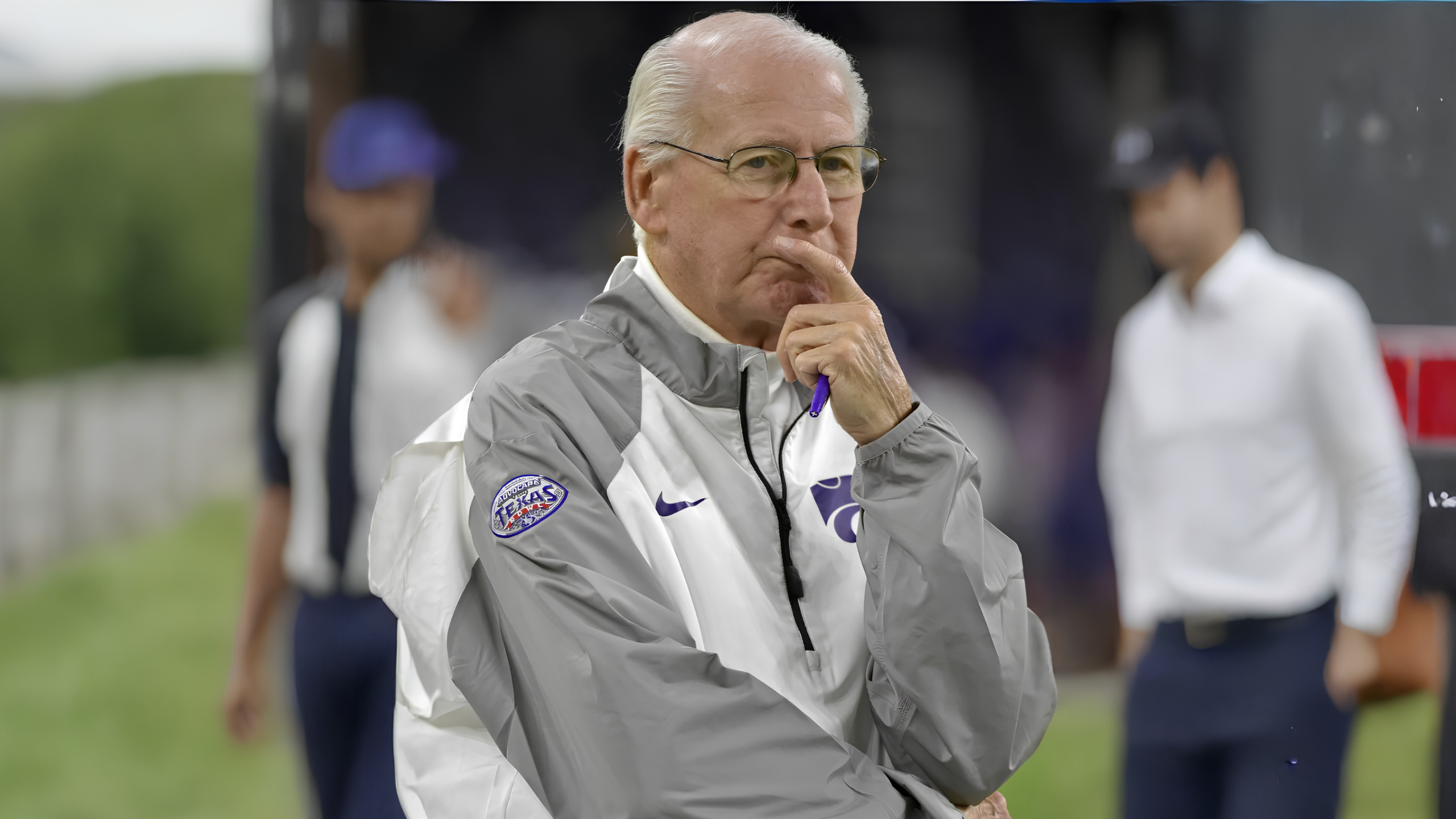
The Place He Inherited
The meeting started at eight. The other one started at one. Nothing about those times was arbitrary.
If you were in the chair by 7:55, with your notebook open and both feet on the floor, you were on Cat Time. If you strolled in at 7:59, you were on your own time, and everyone in the room could tell the difference.
That was the surface of it. Any coach who ever worked for him could tell you the schedule. What you could not learn from the schedule was the hour after it, and the hour after that, and the year after that. What he built in Manhattan, Kansas, between 1989 and the middle of the next decade, was not a program in the way sportswriters use the word. It was a way of keeping a room. Everything else — the wins, the bowl trips, the two Big 12 titles, the stadium that would eventually bear his name — was a consequence of the room being kept.
I was in that building. I came in 1989 as a graduate assistant for Stan Parrish and I was still there when Parrish was fired and Bill Snyder was hired out of Iowa in late November of that year. He kept two GAs from the previous staff: Dana Dimel and me. He moved me up to Volunteer Assistant, which back then was a paid seat working under the offensive coordinator, Del Miller. I coached receivers. I met with faculty. I spoke at Catbacker events in the summer. I did whatever a young coach does when he is trying to earn a second year in a place that had not, on the evidence of the record, earned much of anything.
I left after 1990 for Hofstra to be an offensive coordinator, and I came back in 1994 as tight ends and special teams coach. Both times I walked back into the same room: the chair, the notebook, the minute count on the whiteboard, the man at the head of the table who had, as far as any of us could tell, not left the building.
I am writing about him now because a lot of people write about Bill Snyder and almost nobody writes about the part that mattered.
You have read the numbers before. It is worth reading them again slowly.
Kansas State football, at the point Snyder took the job, had lost more than five hundred games. In thirty-four years the program had produced two winning seasons. It had gone thirty games without a win, dating to a Saturday against Kansas in October of 1986. Sports Illustrated had called the place Futility U. The Board of Regents had, at one point, discussed the possibility of dropping the sport a division. Nobody in the country believed the job could be won. When Snyder took it, several coaches he respected called to tell him he had made a mistake.
The mistake, from the outside, looked obvious. There was no recruiting base. The stadium was half empty in a town of thirty thousand people who had, understandably, stopped expecting anything. The Big Eight, the conference Kansas State played in then, was a two-team league at the top — Oklahoma and Nebraska — and a survival exercise for everyone else. Manhattan was the bottom of the survival exercise.
The football complex itself sat miles from any highway, a quiet cut-off place on the edge of a small college town, and I have come to believe that the isolation was part of why the work he did there was possible. Nobody wandered in. Nothing distracted the room. The building was the world.
Cat Time
Snyder did not walk in with a slogan. He walked in with a list of minutes. That is the part I want you to hold in your head as you read the rest of this, because it is the part almost every retelling gets wrong. The 16 Goals for Success — the poster, the framed thing hanging in every high school locker room in Kansas now — came after. Before there were goals, there were minutes.
I want to describe how the day actually ran, because I have never seen anyone else describe it correctly.
Coaches were expected at their desks well before the eight o'clock staff meeting. The meeting itself was not a stand-up. It was a working session. Each area of the program — offense, defense, special teams, recruiting, academics, equipment, training, film, travel — had a notebook, and the notebook was on the table. Every man in the room had assignments in it, in his own hand, written down the day before. The meeting went through the notebook: what had been done, what had not, what was owed by the one o'clock, and what would be reviewed at eight the next morning.
Then you went to your position room. You installed. You watched film. You met with your players, individually and in groups. You walked the practice script. You knew, before you laced up, exactly what the next two and a half hours were supposed to produce.
Practice itself was choreographed to the minute. Not to the ten-minute period the way most college programs run it. To the minute. If a period was scheduled to end at 3:47, it ended at 3:47, and the horn sounded, and the players who were supposed to be at the second field were already jogging. If a walk-through was scheduled for eleven minutes, it did not run twelve. Time was not a suggestion. Time was the currency of the operation, and the operation did not tolerate the printing of extra bills.
After practice you did not go home. You went to the meeting that followed it. You cut the day's film. You graded. You wrote your card for the next day's install. You compared what you had told a player he needed to fix against what he had actually done. You met, again, as a full staff. And then, when the meeting was over, you sat in your position room and you kept going, because the head coach was still in his office, and the film was still warm, and nobody in the building was going to leave before the man who had asked them to be there.
He did not ask any of us to work harder than he worked. He simply worked at a level most people had never seen up close, and the effect of watching him do it was that you either matched it or you found another line of work. Most of us matched it. Some for a season. Some for a decade. A few for the rest of their careers.
The Cat Clap
There was a sound in that program that I still hear sometimes, thirty-seven years later, when I walk into a room I am about to run.
When Coach Snyder introduced someone new to the players — a recruit on a visit, a new coach, an academic advisor the team had not yet met — the entire team clapped twice. Two claps. In perfect unison. No warm-up, no throat-clearing, no straggling third clap from somebody who did not get the timing. Just two claps, and then silence, and then the introduction continued.
We called it the Cat Clap.
It sounds like a small thing. It was not a small thing. The first time you heard a hundred and fifteen players deliver two exact claps together, you understood something about the discipline of that team that no depth chart could have told you. The Cat Clap was the audible version of Cat Time. It was a program signaling to itself that it moved in unison when it was asked to.
It was also, I now realize, a gift to the person being introduced — a stranger walked into that room and was met by the sound of a hundred and fifteen young men doing one small thing exactly right. You could see it in their faces. They had never been welcomed like that in their lives.
We do not have enough small rituals like that in the organizations I have worked in since. I have tried, in a few of them, to build something like it. When it works, it changes the temperature of the room.
The Purple Pen
I want to be specific about the notebooks, because they are the specific thing I still steal from him.
In every staff meeting there was a notebook for every area of the program: recruiting, academics, equipment, travel, strength and conditioning, nutrition, film, officiating, bowl logistics, team meals, practice schedule, game plan, injury report, community relations, and media. Inside each notebook were the duties of every man on the staff, updated in the last twenty-four hours.
Snyder wrote in those notebooks with a purple flair pen. Always the same pen. Always purple. Next to every task were the initials of the coach responsible for it. If I saw MM next to a line, that line was mine, and it was mine to have finished by the next time he opened the book. It was not a request. It was not a suggestion I might get to when the week eased up. It was a task with a name on it, and the name was going to be read out loud, in front of the room, at the next meeting.
He would go around the room and follow up on every single task. Every one. He would read the item, look at the coach whose initials were beside it, and ask for the completion rate. Not the status. Not the progress. The completion rate. Done, or not done. If not done, why not, and by when. If done, was it done in the way the notebook said it should be done. He was not looking for excuses and he was not looking to embarrass anyone. He was looking to close the loop. Every task, every day, closed or explained.
Nothing was left to someone will handle it. Someone was named. The name was written in purple. The book came out the next morning. The discussion of a missed item was not a dressing-down — it was a working session about what had failed in the system. Was the assignment unclear? Was the deadline unreasonable? Did the person need help? Did we need to rebuild the checklist? Then we rebuilt it. Then we moved on.
People called this micromanagement. I have heard it called that in print for thirty-five years. It is not micromanagement. Micromanagement is a head coach looking over the shoulder of an assistant who has been given a job. What Snyder ran was the opposite. He gave every assistant a complete job, with a clear scope and a written record, and he trusted the record. He did not need to look over anyone's shoulder because the notebook told him what he needed to know. The room did not run on hope. It ran on paper. In purple.
That system is the reason the program improved every year for a decade, and it is the reason the assistants who came out of it — the eleven Division I head coaches, the NFL guys, the coordinators — were, on average, more organized than the coaches they competed against. They had watched an operating system work. They had run pieces of it themselves. They knew what a program looked like when the paper was kept.
Cat Day
Once a year, at the end of training camp, we ran a practice we called Cat Day.
It was one practice. It lasted the whole day. More than eight hours on the field. It was not a scrimmage. It was a rehearsal of every contingency that could ever befall a football team on a Saturday afternoon.
I mean every contingency.
Onside kick, hands team on, ball recovered. Onside kick, hands team on, ball muffed, live ball, scoop and score. Fake field goal, holder up, throw to the wing. Fake punt, personal protector run, twelve yards to move the chains. Two-minute drill from your own eight. Two-minute drill from your own eight with no timeouts. Two-minute drill from your own eight with no timeouts and the backup quarterback in the game because the starter had cramped up. Fourth-and-one from the fifty with the wind. Fourth-and-one from the fifty into the wind. Victory formation with a full house backfield because you were up by six and the other team had one timeout and thirty-eight seconds.
Field goal team on the field with twelve men because someone had not heard the substitution — how do you fix it, who runs off, what does the holder do if the ball is snapped anyway. Kickoff after a safety, free kick, coverage rules different, players who had never done it walking through the alignment. Weather. Delay. Restart. Cold muscles. Next play.
We did it all, in sequence, for hours, until the light went sideways and the pads were soaked through and the trainers had run out of tape. And when it was over, and we walked off the field, every one of us knew something the rest of the country did not know. We knew that nothing that could happen on Saturday had not already happened to us on Cat Day. We had lived it. We had rehearsed the recovery of it. We had watched the film of the rehearsal.
That was the winning edge. It was not a saying. It was a day on the calendar. And it worked because the man who had put it on the calendar sat in every meeting that produced it and walked every walk-through that installed it and graded every rep of every drill that composed it. The confidence Cat Day produced was not a mood. It was a receipt.
I have thought about Cat Day my whole career. Every organization I have built since, in football or out of it, has had some version of it — a day, or a week, or a review cycle, in which the whole thing is stress-tested against the scenarios nobody wants to think about. When I have run those tests, I have won more than I have lost. When I have skipped them, I have paid.
The Pregame Oral Test
There is one more ritual I have to describe, because it might be the most Snyder thing of all.
On game day, after our pregame meal, we would run oral tests on the players.
The room was quiet. The team was fed. The position coach would stand up and call out one of his players by name. He would ask him a question — a specific football question, a coverage read, a protection call, a route adjustment against a look the opponent was likely to show that afternoon. And then a second question. And then a third. The player had to answer, out loud, in front of the entire team, and he had to answer confidently. Not tentatively. Not with a hedge. He had to know the answer and he had to sound like he knew the answer.
The room was tense. I want you to understand that. It was not a friendly little pop quiz. Every player in that room knew he might be next. Every player knew that being unprepared was not an option, because being unprepared in front of the whole team on game day, three hours before kickoff, was worse than any mistake he would make on the field. Nobody was unprepared. Nobody.
That was the point. Confidence for game day did not start with the warm-up. It did not start with the walk-through. It started right there, at the table after the pregame meal, with a hundred and fifteen young men in a quiet room, each of them ready to be called on and each of them ready to answer with both hands on the wheel.
I have watched a lot of pregame routines in my career. I have run several of them myself. The oral test is the one I have never seen anywhere else, and it is the one that I believe made the biggest difference on Saturday afternoons. Snyder had figured out something most coaches never figure out. He had figured out that the difference between a prepared team and an unprepared team was not what they knew. It was whether they had been asked, out loud, in front of their teammates, to prove it.
The Staff
I need to tell you about the staff, because part of what Snyder built was a room full of the best young football minds of that generation, and most people looking at the record do not realize how good the assistants around him were.
The 1989 staff, the one he assembled in the six weeks between his hire and spring practice, was not glamorous on paper. Bob Cope had been the head coach at Pacific. Nick Quartaro had been the head coach at Drake. Tom Grogan came out of the human resources department of an architecture firm in Kansas City, having been an Iowa quarterbacks coach and recruiting coordinator years earlier. Charlie Coe came from Missouri. John Latina came from Temple. Mike Nelson came from San Diego State. Kevin Ramsey was the one holdover from the Parrish staff. And a young defensive backs coach named Bob Stoops came from Kent State, which Snyder had noticed because he had coached Stoops as an All-American at Iowa.
Del Miller was the offensive coordinator I worked under, and he would go on to be the head coach at Missouri State. Dana Dimel, the other GA Snyder kept, would go on to head-coaching jobs at Wyoming, Houston, and UTEP. Bob Stoops would go on to Oklahoma and win a national championship. His younger brother Mike, added the next year from Iowa, would go on to Arizona. Jim Leavitt, added in 1990, would go on to build South Florida from the ground up. Later staffs would include Mark Mangino, Brent Venables, Bret Bielema, Phil Bennett, Rex Ryan, Ricky Rahne, Carl Pelini, Eric Wolford, and Tim Beck.
And then there was Sheahon Zenger. Sheahon came to Kansas State as a graduate assistant out of Drake, by way of Nick Quartaro, and he was quickly given the role of director of football operations. If you want to understand how the Snyder machine actually ran on a Tuesday morning, look at what Sheahon did. He met with Coach Snyder more than any other person in the building. His whiteboard was, at any given hour, covered with hundreds of tasks he had been asked to complete at the highest standard the program was capable of producing.
He took extreme ownership of his piece of the operation. He did not flinch. He did not push back on the volume. He built systems inside systems, because that was what the job required and because he had figured out, faster than most of us, that the volume was not the point — the completion rate was the point.
Sheahon and I stayed close after Kansas State, and a few years later he became my co-founder on American Football Quarterly, the coaching publication we built and ran together, and which grew into the largest football coaching publication in the country. AFQ was a Snyder operation in miniature: notebook for every issue, names next to every task, deadlines that did not move. It could not have been anything else, because the two of us who built it had learned how to build things in the same building, from the same man, at the same table.
Almost everything I know about publishing a football magazine — which is, not incidentally, what I am doing again now with Gridiron Aficionado — I learned first from Snyder and then reinforced across a decade of running AFQ with Sheahon.
What I Did With It, and Where I Broke It
Eleven of Snyder's assistants became Division I head coaches, and that number does not count the athletic directors, the university presidents, the NFL front-office people, and the coordinators-of-coordinators the tree also produced. That is not an accident. That is what happens when a program is run so cleanly that a young coach can see, from his seat in the meeting, what the whole operation looks like from the top.
Snyder taught it. His notebook was on the table. His installs were on the whiteboard. His grading standards were the same for the tight ends coach and the recruiting coordinator and the head man himself. If you paid attention — and paying attention was not optional — you were, in effect, being trained to run your own program by watching him run his.
I want to be honest about a part of my own career that I have not written about much.
For years I ran organizations the way I had watched Snyder run his. When I got my first head coaching job at Emporia State, I built the whole operation on his model. Notebook for every area. Names next to every task. Follow-up on the completion rate. Practice choreographed to the minute. A version of Cat Day in training camp. A version of the pregame oral test on Saturday mornings. It worked. We won there. We won because we were the most prepared team we played, and we were the most prepared team we played because a young head coach in his first job was still running, more or less faithfully, the operating system he had watched a master run in Manhattan.
Later, at Defiance College, I began to give control back. I told myself I was empowering my staff. I told myself creativity would fill the gap. I told myself the checklists could relax a little because we knew each other well enough now. Every one of those sentences was a way of avoiding the work.
The work is boring. The work is a Monday morning going through recruiting call logs and finding that the number a coach reported was not the number that was actually made. The work is walking through the fake-punt look at half-speed on a Wednesday afternoon when the offense wants to install a new formation and the defense wants to be off the field. The work is asking your special teams coordinator, out loud, in front of the room, whether the twelve-men-on-the-field contingency has actually been walked through this week, and accepting the discomfort when the answer is no.
We were an interesting team to watch. We were creative. Our offenses had good weeks. But we were not prepared the way a Snyder team was prepared, and the difference showed up in the five minutes nobody films. The situation nobody had rehearsed. The special-teams look we had drawn on the board but not walked through. The assignment nobody had double-checked because we all trusted each other. We lost games we should not have lost. I know exactly which games they were. I can still name the plays that decided them. And I know that the reason we lost them was that I had stopped running the room the way I had been taught to run it.
The lesson is not that creativity is the enemy of preparation. Snyder was one of the more creative offensive minds of his generation — the schemes he ran at Kansas State pulled from wishbone, from run-and-shoot, from West Coast, from wing-T, from wherever the best idea for a given personnel group lived. He was not conservative. He was prepared. Those are different things.
Creativity without the notebook is a hope, and hope has never beaten a team that ran Cat Day.
What Lasted
The record is real. Two hundred and fifteen wins, the most in Kansas State history, and more, by themselves, than every other coach in the program's history combined from 1928 forward. Two Big 12 titles, in 2003 and in 2012. Six top-ten finishes. Nine ten-win seasons. Eighteen bowl games. A stadium renamed Bill Snyder Family Football Stadium the day after he first retired in 2005, and a statue outside it. A town, Manhattan, that stopped apologizing for Saturday afternoons and started ordering them.
The record is real, but the record is not what lasted for the people who were in the building.
What lasted is the eleven head coaches, and the two national champions among them, and the coordinator staffs they built, and the coordinators they produced, and the coordinators those coordinators produced. What lasted is a coaching tree that has arguably shaped college football more than any tree of the last forty years except Bill Walsh's. What lasted is the vocabulary — process, culture, details — that the rest of the country later borrowed and sanded down into something you could put on a slide.
The original was narrower and harder. It was a man in an isolated football complex outside a small Kansas town who believed the game was lost in the five minutes nobody filmed: the empty practice field, the walk-through that ran long, the assistant who had not yet learned that both feet on the floor was not a rule about manners but a rule about attention, the player who had not yet learned that being called on after the pregame meal was not a test of what he knew but a test of whether he could say it out loud.
For me, thirty-seven years after I first walked into that building as a graduate assistant, what lasted is a way of seeing. When I sit down now to build the operating structure of a football league — an eight-club system with a media schedule and a broadcast inventory and a governance package moving through owner review — I sit down with a notebook for every area of the operation. I write the initials of the person responsible next to every task. Not in purple. I have never been able to bring myself to steal the purple. But everything else.
When I build a magazine, which is what I am also doing now, I build it with a schedule of minutes and a script for the day nothing goes right. When I hire, I hire for the person who will sit in the chair five minutes early with the notebook open. When I fail, and I have failed, it is almost always because I stopped keeping the room.
That is what he actually built. Not the turnaround, though the turnaround was one of the great feats of American sport. He built the habit that made the turnaround possible, and he built it in men who would go on to build it in other men, in other buildings, in other conferences, for a generation.
I learned that from him. I have run my own rooms since. Some of them held. Some of them did not. The ones that held owed something to those odd minutes on the schedule in Vanier, when the work was still small enough to see, and a hundred and fifteen young men in a quiet room clapped twice, in unison, because that was how you welcomed someone into the sanctum.