
When I think about Hofstra football, I think about Wayne Chrebet in the snow.
He had a teammate from Connecticut, a running back named Jeff Becchetti, and the two of them were always training. They were always in the weight room, and then they'd go outside, strap parachutes to their backs, and run into the cold. They were dragging all that wind behind them because they were trying to get faster.
Wayne was not a fast receiver. He was quick, and anyone who has coached the position knows those are different gifts. Speed is what a stopwatch measures. Quickness is what a cornerback feels in his hips half a second too late. Wayne had the second one in abundance, and he spent his winters chasing the first one anyway, because that was the kind of young man he was. Whatever he had, he wanted more of it.
He had come to Hofstra without a football scholarship. Nobody on the roster had one; it was a Division III program. For his first two years he played a limited role. He stood five-ten and maybe 180 pounds, and every year the program brought in bigger, faster recruits who looked, on paper, like his replacements. Nobody in that building was promising him anything. Certainly nobody was promising him eleven seasons with the New York Jets, which is what he went on to have.
When people talk about Hofstra football now, the NFL names come up first. Chrebet, Colston, Colon. I understand that. They're the names people recognize, and they help explain the level of football that was played on that campus. But I knew some of those young men before anybody knew what they would become, and that's the part of the story I want to keep.
For seventy-two years, Hofstra University fielded a football team. Then on a Wednesday night in December 2009, its trustees voted to stop. This essay is about what that program was and who built it. It's about what it did for people that no budget line ever measured, and what went with it when it was gone.
A college on an estate
Hofstra began in 1935 as an extension of New York University, on the Hempstead estate that William and Kate Hofstra had left behind. It opened with about 150 students. It became Hofstra College in January 1937, and that fall it put a football team on the field. The teams were called the Flying Dutchmen in honor of the family whose name was on the deed, and they kept that name until 2001.
So football was there almost from the beginning. It wasn't something a mature university bolted on later to raise its profile. It grew up with the place. By the late 1940s, the program had a halfback named Walter Kohanowich whose No. 33 would become one of the first numbers Hofstra ever retired. The school was barely a decade old and already had its first football legend.
That matters to the argument I'll make later. When an institution ends a program that old, it isn't cutting an expense that crept onto the books. It is cutting part of its own origin story.
Howdy Myers and the Tiny Twenty
In 1950, Hofstra hired Howard "Howdy" Myers. He came from Johns Hopkins and had won lacrosse titles there, and for the next quarter century he was Hofstra's head football coach, head lacrosse coach and athletic director, often all in the same week. His football teams went 141–98–4 over twenty-five seasons, with fifteen winning years.
Two of his teams belong in any history of the program.
The first was the 1956 team, remembered as the Tiny Twenty. Myers started that season with about twenty players. At one point injuries had left him thirteen, two above the minimum needed to field a team. A thirteen-man roster is barely a practice; you can't even run a full scrimmage. That team went 7–3 anyway. I've coached a lot of football and been around a lot of rosters, and I have trouble imagining how you install anything, let alone win seven games, with that many bodies. But that's the program's founding temperament in one season. They made do and played anyway, and they won more than they lost.
The second was the 1959 team, which went 9–0. It was the first unbeaten season in Hofstra history, and the university later inducted the whole team into its athletics hall of fame.
One of Myers's early captains is the most important figure in this story who never coached a down. James Shuart captained the 1952 team, which lost only one of nine games, to Alfred, on a punt that took a strange bounce off a Hofstra blocker. Shuart studied history. Twenty-four years after that season, he became president of the university, and he held the job from 1976 until 2001.
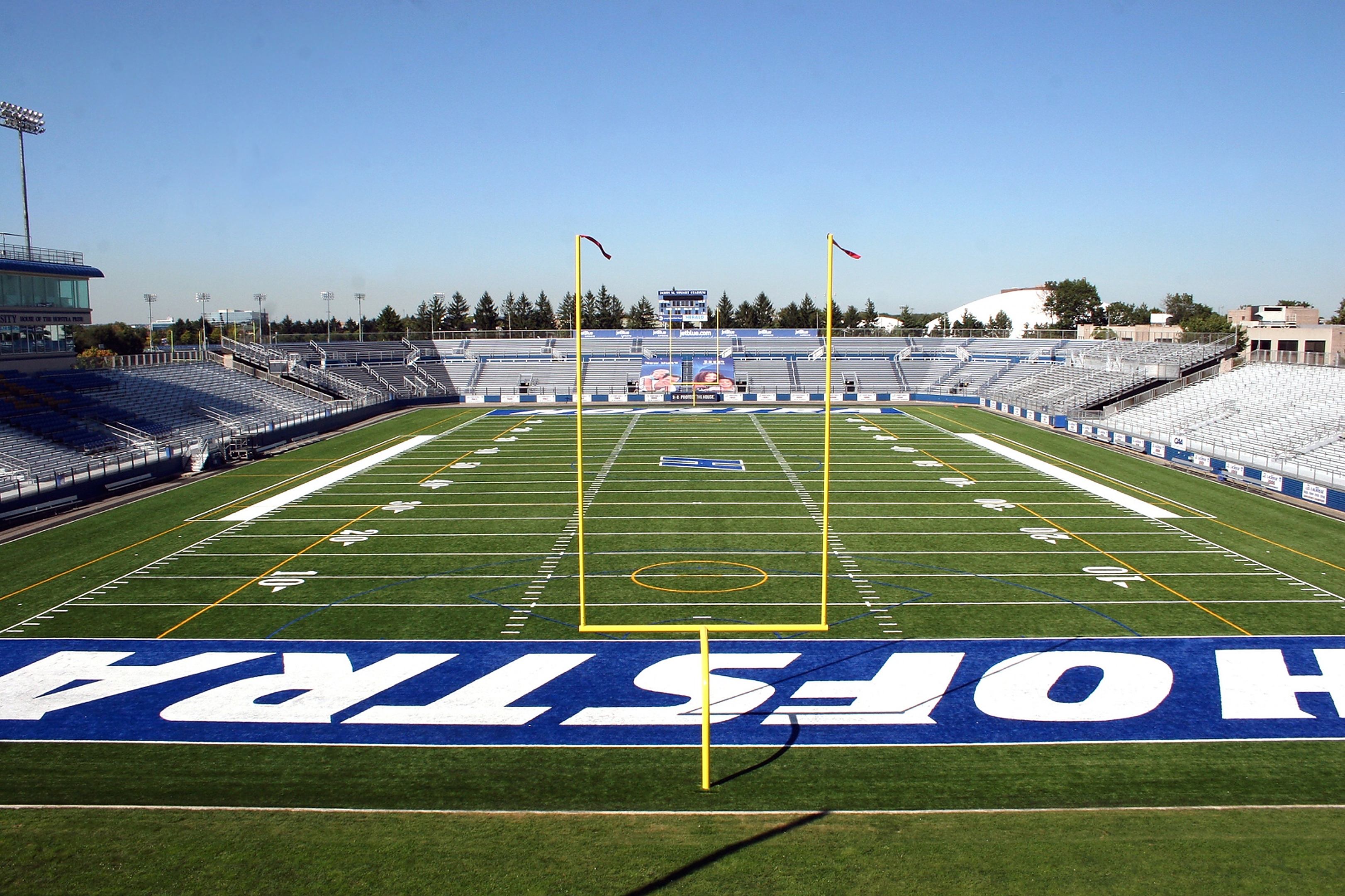
Think about that for a moment. For a quarter century, the man running Hofstra had been the captain of its football team. Everyone who coached there in those years, me included, worked under a president who understood from the inside what the game could do for a young man. Later, the stadium was renamed for him. James M. Shuart Stadium still stands on the south side of the campus.
Hofstra football also made it onto one of the best-selling comedy records of the 1960s. On his 1965 album, Why Is There Air?, Bill Cosby recorded a routine called "Hofstra." In it, he described his Temple team lining up against Hofstra players so enormous that the routine turns them into something close to myth. It was comedy, and it exaggerated everything. But a comedian doesn't build eight minutes around a program nobody has heard of. By the mid-sixties, Hofstra was a name a national audience would recognize.
My experience was the opposite of the Cosby routine. When I got there, we weren't looking for giants. We were looking for young men who hadn't become giants yet.
Long Island's football address
In the summer of 1968, the New York Jets came to Hofstra for training camp. Hofstra wasn't the team's first choice. The team had spent the previous five summers in Peekskill, and before that had moved around from New Hampshire to Bear Mountain to East Stroudsburg. Hofstra offered a campus, dormitories and a stadium, and that year the stadium became the first outdoor field in the East to install AstroTurf. The Jets lived in Tower D that first summer and practiced on the north campus with Axinn Library in the background. That season ended in January with Joe Namath guaranteeing a win in Super Bowl III and then delivering it.
They kept coming back. In 1974, the Jets moved their offices to the campus permanently, into a building that would carry Weeb Ewbank's name. For forty years, from Namath to Brett Favre, a professional football team lived on the same grounds as a college football team. Every summer, thousands of Long Islanders watched NFL practices for free across the road from Hempstead Turnpike.
Hofstra, in other words, was the address of professional football on Long Island. If you were a high school kid in Nassau County, you knew the Jets practiced at Hofstra. If you were a recruit, you could see where the game might take you on your official visit.
One of the men who worked in that Jets building would go on to change the college program. Joe Gardi was a Jets assistant from 1976 through 1984 and helped shape their defenses out of Weeb Ewbank Hall. In 1984 he was let go. Six years later, in the winter of 1990, he walked to the field house on the south end of the same campus and became Hofstra's head football coach.
"I just wanted to be called Coach again," he said.
The climb
Joe's first Hofstra team went 10–0 in the regular season, won the school's first NCAA playoff games and reached the Division III national semifinals. It lost there to Lycoming on December 1, 1990, by a score of 20–10. That team also led all of Division III in passing, at 342.2 yards a game, and in total offense, at more than 500 yards a game. Rob Spence coordinated that offense and ran the run-and-shoot well, and I want to make sure he gets credit for it. A lot of what I walked into had been built by him.
I came from Kansas State after the 1990 season. I had been coaching receivers for Bill Snyder in the first two years of what became the most improbable turnaround in college football. Joe brought me in to coordinate the offense just as Hofstra was preparing to do something few Division III programs had ever tried: move up to Division I-AA, without scholarships, against opponents who had them.
That was the first thing that struck me about the place. It was ambitious. The second thing was how hungry the players were. There were early-morning workouts and extra work, and whatever we asked of them, they went after it. They knew the schedule was changing and that the teams across the line were going to be bigger and better funded. They wanted to find out if they belonged. Some of them had been told all their lives that they didn't. Hofstra was their chance to find out.
The 1991 schedule had six Division I-AA opponents on it, and we went 8–2. We threw for 4,035 yards in ten games, or 403.5 a game. We set school records that season for attempts, completions and passing yards, and they still stood when the program closed. We also tied the school record for touchdown passes. Because we played a mixed Division III and I-AA schedule, we never appeared in the NCAA's official tables that year. But 403.5 a game was more than the official passing leader in any division threw for. That included Houston, whose run-and-shoot led Division I-A at 372.8. On October 19, 1991, our quarterback, Tim Lynch, threw for 585 yards and completed 50 passes against Fordham, a I-AA program. Both numbers went into the NCAA record book, and so did the combined total: the two teams completed 80 passes for 987 yards. Thirteen years later, Hofstra quarterbacks were still chasing Tim's 585.
I brought my own version of the run-and-shoot, and Joe gave me room to run it. Joe was a defensive coach, and he gave his offensive coordinator real freedom, which is rarer than people think. He didn't second-guess every call. He let me learn.
People sometimes describe the run-and-shoot as a soft offense, as if throwing the football means you're not tough. That was never how we looked at it. We competed in practice. We expected players to prepare, to know their responsibilities and to carry them out. A receiver in that system has to read coverage on the move, adjust his route in the middle of it and arrive at the same spot at the same moment the quarterback decides to throw there. That isn't soft. It's demanding in a different way, and it rewards the young man who studies.
We had an unusual staff, too. Kevin Keeffe coached the running backs and ran the strength program. Frank Limanni coached our offensive line part-time, because his full-time job was at Rikers Island. Frank was a former Marine, and he's one of the best offensive line coaches I've ever been around. Jimmy Crane was from The Woodlands, Texas. He'd come to New York because his wife had taken a job in the fashion industry. He stopped by one day while we were doing spring work, and before long I'd made him our receivers coach. We've been friends ever since.
That was the offensive staff: a line coach with a day job at Rikers Island, a strength coach, a Texan who happened to be in town, and a young coordinator not long removed from being a graduate assistant. Nobody would have assembled that group on purpose. It worked because of the man running the building.
Wayne
Wayne had a chip on his shoulder, and I don't think he ever fully lost it.
We kept recruiting receivers who could really run, and I believe Wayne sometimes looked at those kids, and at me, as if I were trying to replace him. I wasn't. In our offense, speed on the outside was a tool for the man inside. You put fast receivers on the perimeter and send them deep. The safeties have to respect them. The corners have to turn and run. The field gets longer and wider, and somewhere in the middle of all that space, a quick, smart receiver is left alone with one defender.
Today you'd call Wayne a slot receiver. We called it getting him isolated. Once he was isolated, he had an uncanny knack for what I call a trigger move. He would sell a defender one direction, just enough to get his weight committed, and then break the other way. It wasn't a big move. It didn't need to be. Half a step was all he needed. Then the ball would arrive, and Wayne would catch it. He always caught it, sometimes to his own detriment, because he'd hold onto the ball when a smarter man might have gone down. What I remember is that the ball got there and Wayne secured it.
The mental side of his game was something to behold. He wasn't going to win every foot race, and he knew it, so he made the race irrelevant. He understood leverage and timing, and how a defender's eyes tell you where his feet are going. That's why you have to be careful evaluating receivers by their forty-yard times alone. The stopwatch doesn't cover anybody. You have to see what a young man does when someone is trying to stay in front of him.
Joe also put him on special teams. Wayne wasn't there only to catch passes. Years later, Jets fans would call him a hard-hat guy, and he already was one at Hofstra. When I talk about Wayne's toughness, I mean his work, his willingness to contribute anywhere, and his competitiveness every day. I don't mean collisions. He helped set the standard for the room.
I coached him for three seasons. Then I left, and in 1994, his senior year, everything we'd been working toward arrived at once. He became the first receiver in Hofstra history to go over 1,000 yards. He finished with 1,200 and sixteen touchdowns. At Delaware, he caught 14 passes for 245 yards and five touchdowns, tying Jerry Rice's I-AA record for touchdown catches in a game. He left Hofstra with the school records for receiving yards in a game and in a season, and touchdown catches in a game, a season and a career. As a senior, he won the Iron Mike Award as the team's most valuable player.
Then no NFL team drafted him. He signed with the Jets as a free agent and spent eleven seasons with them. He never played for anyone else. When he reported to the Jets, he reported to the same campus where he'd run with parachutes in the snow.
I didn't know any of that would happen. I knew what he brought to our team.
Dave
Dave Fiore came to us in a completely different way.
The first time I saw Dave, he was playing basketball at Waldwick High School in New Jersey. He looked like Bambi: long and loping, a young man who hadn't grown into his own body yet. But watch him move. Watch him go after a rebound. Look at that reach, that wingspan. I remember thinking that he had the frame of a Division I football player and just wasn't there physically yet.
And he could compete. He had a fire in him that didn't depend on what game he was playing. I don't remember having to talk him into football. Dave wanted to belong somewhere. The idea of coming to Hofstra and taking on a challenge that big appealed to him.
Then you got to know him. He was brilliant. He was always learning, always studying, always asking questions. He played center and he played tackle, and he cared about understanding his own body: how it worked, how to train it, how to make it better. In a game that often treats linemen as mass, Dave treated himself as a project.
I have to give Frank Limanni a great deal of credit for what Dave became. A coach can find a young man with a frame and some ability, but somebody has to coach him, and the young man has to be willing to do the work. Frank coached him, and Dave did the work. When I say Frank is one of the best line coaches I've ever been around, Dave is a big part of the reason. That basketball player from Waldwick played guard in the NFL. He spent most of his career with the San Francisco 49ers, from the mid-nineties into 2002, and then played a season in Washington.
But that's not what I was looking at on the basketball court. I was looking at somebody who could become a good football player if we gave him the opportunity and helped him develop.
Wayne and Dave had different bodies and played different positions. Neither looked like the finished product when Hofstra found him. Both were smart and both were tough. Each was willing to compete against himself, and each wanted to be better than he had ever been. That combination is what a program is really recruiting, whatever the depth chart says.
DeMingo
DeMingo Graham came to us yet another way.
I was running run-and-shoot camps at Hofstra and helping a high school coach from Newark install the offense for his program. He brought his team over to campus. Frank and I saw DeMingo, a big kid from Newark Central, and we both loved his frame right away. He had wrestled, too, which always caught my attention in an offensive lineman. A wrestler knows leverage. He knows how to win with his hands and his hips while somebody is trying to move him.
We kept in touch with his coach and with DeMingo, and especially with his mother. As I remember it, Syracuse was recruiting him as well. I'm not saying Syracuse couldn't have taken care of him. I'm telling you what I believe mattered to DeMingo and his family. Hofstra was closer to home, so they could come watch him play. There was a real chance to get on the field early and develop. And it felt like family to them. They were comfortable with the people and comfortable with the place.
We brought him in quietly in December 1993 and got the paperwork done. He was the last player I recruited at Hofstra before I went back to Kansas State. A lot of coaches were surprised that he chose us.
He enrolled in 1994 and started at guard for four years. In 1997, his senior season, a young line coach named Kyle Flood arrived at Hofstra. Kyle later told me how amazed he'd been by the quality of linemen he'd inherited. DeMingo went undrafted, made the San Diego Chargers anyway, started for them, and then played for the Houston Texans in their first season.
It's a long way from a summer camp on Hempstead Turnpike to the starting lineup of an NFL team. But that's where the relationship started, and it gave Hofstra the chance to develop a very good football player whose family trusted us with him.
The building Joe kept
I'm saving most of what I have to say about Joe Gardi for another time; he deserves his own telling. But you can't understand why Hofstra worked without knowing a little about the building he ran.
Joe respected his coaches. We had Sunday meetings, and he brought food in for the staff. It's a small thing, and it's not a small thing. I could walk into his office, get on the whiteboard and work through an offensive idea with him, and he never made me feel like a young coordinator who should have known better. Joe and Greg Gigantino were outstanding defensive coaches. I wanted to know how they'd attack the concepts I was drawing up, and those conversations made us all better. It was never offense against defense in that building. We competed, certainly, but we competed for the same thing.
Joe also coached special teams himself. He called it "the winning edge." Think about what that does to a team. Every week, offensive players and defensive players stood in the same meeting under the head coach, working on the same unit with the same responsibility. A program that does that tells its players something every day about who they belong to.
So when we sat in a family's living room in Newark or Waldwick, I felt good about what we were telling them. It was true.
It kept working
Programs that rely on one great recruiting class or one charismatic coordinator tend to fade when those people leave. Hofstra didn't.
In 1995, the Flying Dutchmen went 10–2, finished ranked tenth in Division I-AA and made the I-AA playoffs for the first time. They reached the quarterfinals in 1998 and again in 1999, the year they won the Lambert Cup as the best I-AA team in the East. In 2001, they shared the Atlantic 10 championship. Under Joe, Hofstra made five I-AA playoff appearances in ten years. A non-scholarship Division III team that had moved up only a few years earlier was playing nationally ranked football.
The players kept coming through. Marques Colston arrived in 2001 and was drafted in the seventh round by New Orleans in 2006. He became the Saints' career receptions leader, with 711 catches, and won a Super Bowl with them. In that same draft, Pittsburgh took Willie Colon in the fourth round. He started at tackle and won a Super Bowl with the Steelers. Kyle Arrington went undrafted and won a Super Bowl ring in New England. Altogether, Hofstra sent dozens of players into professional football.
Lance Schulters took the longer road. He came out of Canarsie High School in Brooklyn and played at Nassau Community College, just down the road in Garden City, before transferring to Hofstra in 1996. He had two seasons there. San Francisco drafted him in the fourth round in 1998. In his second year he won the starting job at free safety, intercepted six passes and made the Pro Bowl. He played ten seasons, with the 49ers, Titans, Dolphins and Falcons, and finished with 19 interceptions. Then he went into coaching. In 2021 he joined the Los Angeles Rams staff, where Raheem Morris, his teammate in Hofstra's secondary, was the defensive coordinator, and that season the Rams won the Super Bowl. In 2024 he followed Morris to Atlanta.
So did the coaches. Dan Quinn coached Hofstra's defensive line from 1996 through 1999 and was its defensive coordinator in 2000. Raheem Morris played safety at Hofstra from 1994 through 1997, then stayed on as a graduate assistant and came back to coach the secondary. Kyle Flood went on to become a head coach in the Big Ten. Coaches from those staffs went on to NFL sidelines and major-college head jobs.
The point isn't the names. They're recognizable, and they show you the level of football being played on that campus. But this was never one lucky class or one fortunate run. Different people came through at different times, and the place kept developing them. That's the definition of a program, as opposed to a team.
The NFL isn't the measure of whether it mattered, either. A coach's job is to have a positive effect on a young man's development, and that matters whether he plays on Sundays or never plays another down after college. Most of the young men who played at Hofstra never played professionally. Their football years still counted. They had been held to a standard at nineteen by people who cared whether they met it, and they carried that into whatever came next.
Joe retired after the 2005 season with a record of 119–62–2. To replace him, Hofstra hired Dave Cohen, a Long Islander who had been Delaware's defensive coordinator.
Two departures
On August 20, 2008, the Jets held their last open practice at Hofstra. After forty summers, they moved their headquarters to a new facility in Florham Park, New Jersey. The scoreboard from their practice field is still on the campus.
Fifteen months later, the college team played its final game. On November 21, 2009, Hofstra beat Massachusetts, 52–38, at Shuart Stadium. The team finished 5–6. Nobody on that sideline knew it was the last game.
Two days later, Northeastern announced it was dropping football. On the night of Wednesday, December 2, Hofstra's board of trustees met. On the recommendation of President Stuart Rabinowitz, they voted unanimously to end the program, effective immediately. The university announced the decision the next morning.
The man who had to face the players that morning wasn't Joe Gardi. Joe had been retired for four years. Hofstra's head coach in 2009 was Dave Cohen. He grew up in Commack and played defensive tackle at C.W. Post. His first Hofstra team went 2–9, and his second went 7–4, the second-biggest improvement in the Football Championship Subdivision that year. That season made him a finalist for the Eddie Robinson Award, given to the subdivision's top coach. His fourth team had just finished 5–6. At nine o'clock on the morning of December 3, the president told him the program was over. Within hours, about sixty of his players were in a room hearing the same news. The university said it would honor his contract.
When I heard, I was in shock all day. I believe it was Greg Gigantino who called me; he was at Bryant by then. Neither of us could believe it. All I could think about was what that program had: a president who had been its captain for a quarter century, the facilities, the people around it, and the sense that we were building something that would last. Now it was over.
I want to be careful here, because I wasn't in the room for those discussions. The university said it had conducted a two-year review of its spending. It put the annual net cost of football at about $4.5 million, including scholarships, and it cited a lack of interest and support from students and alumni. It said the money would go into academic programs, new faculty and need-based scholarships. There were 84 players on that roster, from fifteen states, and eleven coaches. The university said players who stayed would keep their scholarships, and those who transferred could play right away.
Those provisions mattered, but they didn't give a young man back what he'd signed up for. He had chosen a school and a team. He had put in the work, the winter workouts and the summer heat. Then one morning in December, the team didn't exist.
Joe wasn't on the sideline anymore, but people still called him, because the program everyone was mourning was the one he had built. That afternoon, Jerry Beach, a Hofstra graduate and sportswriter who had covered his teams, asked Joe whether he was surprised.
"Nope," he said. "I've been expecting it for years."
Asked why, he said, "No comment." Then he kept going.
"I feel, personally, that my legacy is gone. And I thought it was a pretty good one. My daughter started crying. My wife started crying. It's a sad day. But I'm not surprised."
He said three times how concerned he was for Cohen and his staff. Then he said what he was proudest of: "We gave so many young men an opportunity to have a great education and play football at a very high level."
Our reactions are worth setting side by side. I was in shock all day. Joe, who had spent sixteen years inside that building, saw it coming. I won't guess what he knew or what he meant by "no comment." I'll only say that the man who had built the program, and the man who was leading it when it ended, were both worried about the young men in it.
Six months later, in June 2010, Joe died at the age of 71.
Dave Cohen kept coaching. He was Western Michigan's defensive coordinator, then coached at Rutgers, and then spent eleven seasons at Wake Forest. He coached the defensive line there and eventually became assistant head coach, working for Dave Clawson, a friend since they had shared a house as young assistants at Albany in 1989. When Clawson stepped down after the 2024 season, he said the two of them had started together and finished together. On Long Island, Cohen is still remembered by the title nobody would choose. When the Suffolk Sports Hall of Fame inducted him in 2024, it described him as Hofstra's last head football coach.
What the ledger leaves out
I want to argue this fairly, because the easy version of the argument is wrong.
Universities have to make decisions about money. Four and a half million dollars a year is real money. The interest the university cited was a real problem, too. Willie Colon, who loved that program, has said plainly that during his years there, the people in the stands were mostly the players' parents. And what Hofstra built with the money and the ground is real. The space on campus where the Jets had worked became the site of a medical school building, finished in 2015. The university's own student newspaper later traced some of the football money to the founding of its medical school. A medical school is a serious good. I'm not going to sneer at it.
What I object to is the way the choice was framed: as football against education. That's the very thing I disagree with. Done properly, the work coaches do with young men is part of their education. Wayne Chrebet learning to read leverage was learning. So was Dave Fiore studying his own body, and so was DeMingo Graham's family choosing a place where their son would be known. So were the August practices, the film sessions and the Sunday meetings. Football isn't the opposite of what a university does. At its best, it's one of the few places on campus where a nineteen-year-old is held to a standard every day by adults who know his name.
You still have to answer the financial questions. I'm not suggesting otherwise. I just believe the discussion ought to include what the program contributes, not only what it spends. A budget can count the cost of a football program to the dollar. It has no line for what the program gives the people in it.
What bothered me most was the question I wanted somebody to ask: what would it take to make this work? How do we get more people involved? How do we build the support? How do we use what we've already built over seventy-two years, the stadium, the alumni and the professional pipeline? I wasn't in the room, and I can't tell you every option they considered. But from where I sat, I wanted to see the program treated as something worth building on. I knew what it had done for people.
Hofstra had already shown what it could do when it decided to build. In 1991, it took a Division III team without scholarships and pointed it at Division I-AA. Within five years, that team was ranked tenth in the country. That was a university willing to bet on itself. In 2009, it decided to stop betting. Long Island was left with one Division I football program, at Stony Brook.
Then there are the losses no review can measure. The players who had to leave and the coaches who had to start over are the visible part. The invisible part is every young man who never got to choose Hofstra afterward. I'm not claiming the program would have produced another Wayne Chrebet. Nobody can know that. But we do know what the opportunity meant to the ones who were there. We know how a quick receiver found his role, how a long, loping basketball player grew into an NFL guard, and how a family in Newark felt good about sending their son down the road. None of it would have meant anything if the daily experience hadn't lived up to what we promised. Coaches and players made sure it did, every single day.
A football program also gives a university something beyond the game: a reason to come back in the fall, a link between one graduating class and the next, and something to follow long after you've left. My understanding is that former Hofstra players still get together in New York City and talk about those years. That doesn't surprise me. They aren't remembering scores. They're remembering who they were with and what they went through together. That's part of the value, too, and no budget has ever had a line for it.
A proposal to Hofstra
This section is for the people who lead Hofstra now: President Susan Poser, the Board of Trustees and Rick Cole Jr., the athletic director. I've never met you. I coached on your campus for three years, I've spent my life in this game, and I'm asking for one thing.
Study bringing football back.
I'm not asking for a vote or a promise. I'm asking for a serious, public look at what it would take, the question nobody asked in 2009. You're in a position to ask it in a way your predecessors weren't. President Poser arrived in 2021. Rick Cole Jr. has run the department since 2018. None of you has to defend the 2009 decision in order to take a fresh look. That's not a criticism of anyone who made it. Universities change, and so do the facts.
Why now
Three things are true now that weren't true in 2009.
First, your conference has room. Hofstra was a founding member of CAA Football in 2005, and it still competes in the CAA in its other sports. In the past two years the football conference has lost Delaware to the Football Bowl Subdivision and Richmond, William & Mary and Villanova to the Patriot League. It added Bryant and, this fall, Sacred Heart. I can't speak for the CAA, and I won't pretend to. But a founding member with a stadium, a New York market and seventy-two years of football history would be a serious conversation for any commissioner.
Second, Long Island has shown it still wants the game. When Hofstra stopped playing, the island was left with one Division I program, at Stony Brook. Now it has two. LIU combined its athletic programs and began playing Division I football in 2019. Last season the Sharks went 6–6 and won at Eastern Michigan, their first win over a Bowl Subdivision opponent.
Third, other universities have now done this, and they've left a record you can study.
What you already have
Most schools that bring football back have to build a stadium first. You don't.
Shuart Stadium was rebuilt for football. The 1996 renovation added television lighting, a press level, club suites and locker rooms. It seats close to twelve thousand, and it got a new playing surface this spring. Football is still played on it every year. The Empire Challenge brings the best high school seniors from Long Island and New York City there each June, and one of those games drew 9,762 people. Long Island's high school championship games are played there, too. The best young players on the island already know your field. They just leave to play college football somewhere else.
You also have something no new program can buy: alumni. Seventy-two years of former players, coaches, managers, band members and students who grew up with Hofstra football on Saturdays. Some of them still get together in the city to talk about those years. A program that comes back is coming back to people who remember it.
What other schools learned
Mercer University stopped playing football after 1941. Its trustees voted in 2010 to bring it back. In 2013 the Bears played their first game in seventy-two years, before an overflow crowd of 12,172, and went 10–2, the most wins ever by a first-year Division I program. They started in a non-scholarship league and moved up to scholarships the next year. Their football team shares its stadium with their lacrosse teams, as yours would. They won Southern Conference championships in 2024 and 2025. Mercer's senior vice president for marketing said, "I have never seen anything animate our alumni base and our community like football has."
East Tennessee State dropped football in 2003 for financial reasons and brought it back in 2015. In the first season back, attendance was higher than in the last season before the shutdown, and ticket sales were greater than the three seasons before the shutdown combined. The university counted about four hundred additional students and estimated football's impact at more than $22 million a year. Donors to the athletic fund doubled, and so did their giving.
UAB shut down football after 2014. More than eighty-four percent of voting students approved a fee to help bring it back, and a campaign raised $43 million by the spring of 2017. Enrollment, which had dipped the year football was cut, rose to a record. The first game back drew 45,212, the largest crowd in school history.
I'll be straight about the limits of those examples. UAB's attendance rose when football returned and then leveled off. Bringing a program back is expensive and complicated, and the financial return is often hard to see. Enrollment rises for many reasons, and football is only one of them. Most college programs don't make money. Anyone who tells you football will pay for itself is selling something. What these schools gained was harder to count and, I'd argue, worth more: alumni who came back, donors who gave again, students with a reason to stay on campus in the fall, and a community that saw itself in the university.
What a study should answer
If I were writing the charge for that study, it would ask five questions.
- The model. Should Hofstra start without scholarships, the way Mercer did and the way Hofstra played before 1991, or go straight to a scholarship program in the CAA?
- The cost. What would it cost each year to run each model, counting the stadium Hofstra already owns?
- The money. How much of that could alumni and donors commit before a decision is made? How much could come from a student fee, if students vote for one, as they did at ETSU and UAB?
- The conference. What would the CAA, or another conference, require?
- The return. What would a program mean for applications, enrollment, alumni giving and Hofstra's place on Long Island, measured honestly against what other schools actually saw?
How long it takes
The record suggests about three years from decision to kickoff. Mercer voted in 2010 and played in 2013. East Tennessee State announced in 2013 and played in 2015. UAB reinstated its program in 2015 and played in 2017. A decision in the next year or two could put a Hofstra team back on the field before the end of the decade.
Why I'm asking
In 1991, Hofstra took a Division III team without scholarships and aimed it at Division I-AA. Within five years it was ranked tenth in the country. That was a university willing to bet on itself. I was there for part of it, and I know what it did for the young men who played.
I'm not asking Hofstra to repeat 1991. I'm asking it to find out whether it can. Put real numbers next to real benefits, invite the people who care about this program into the room, and decide with your eyes open. If the answer is no, you'll have reached it honestly. If it's yes, the stadium is ready, the players are on the island and the conference has room.
I'd be glad to help in any way I can.
What is kept
Until then, what's left is what was kept. The stadium still carries the name of the 1952 captain who became the university's president. The Jets' scoreboard is still on campus. Chrebet's No. 3 is retired, and so are Kohanowich's 33 and Colston's 89. The 1959 team is in the university's hall of fame.
Those things are kept, but they aren't the main thing. The main thing is a set of habits that left Hempstead in the bodies and minds of the people who learned them. They went to New Orleans and Pittsburgh and San Diego, and into classrooms and coaching offices and family rooms. A university can vote to end a team. It can't vote away what that team built in the people who passed through it.
I didn't know Wayne and Dave and DeMingo would have long NFL careers. I knew they were each smart in their own way and competitive, and I knew they were willing to work. Hofstra gave them a place to do it.
That's what I want remembered. Not just the players who made it to the league, but the opportunity the program offered all of them before anybody knew how their stories would turn out. And a quick kid from New Jersey, running into the wind in the snow with a parachute behind him because he wanted to be a little faster than he was.
They closed more than a football program.
This essay expands on Notebook 005 from The Gridiron Aficionado Show, "Hofstra: They Closed More Than a Football Program." Watch Notebook 005. The next Notebook turns to Joe Gardi, and why so much of this worked.
Feature photo: Abel Bainnson Butz, LLP.
Manny Matsakis was Hofstra's offensive coordinator from 1991 through 1993. He is the Publisher of Gridiron Aficionado, Founder and CEO of the Continental Football League, and founder of the Tiger Ellison Society.
Kept is the Sunday letter from Gridiron Aficionado, for readers who love the game beyond the headline cycle. Get Kept.