
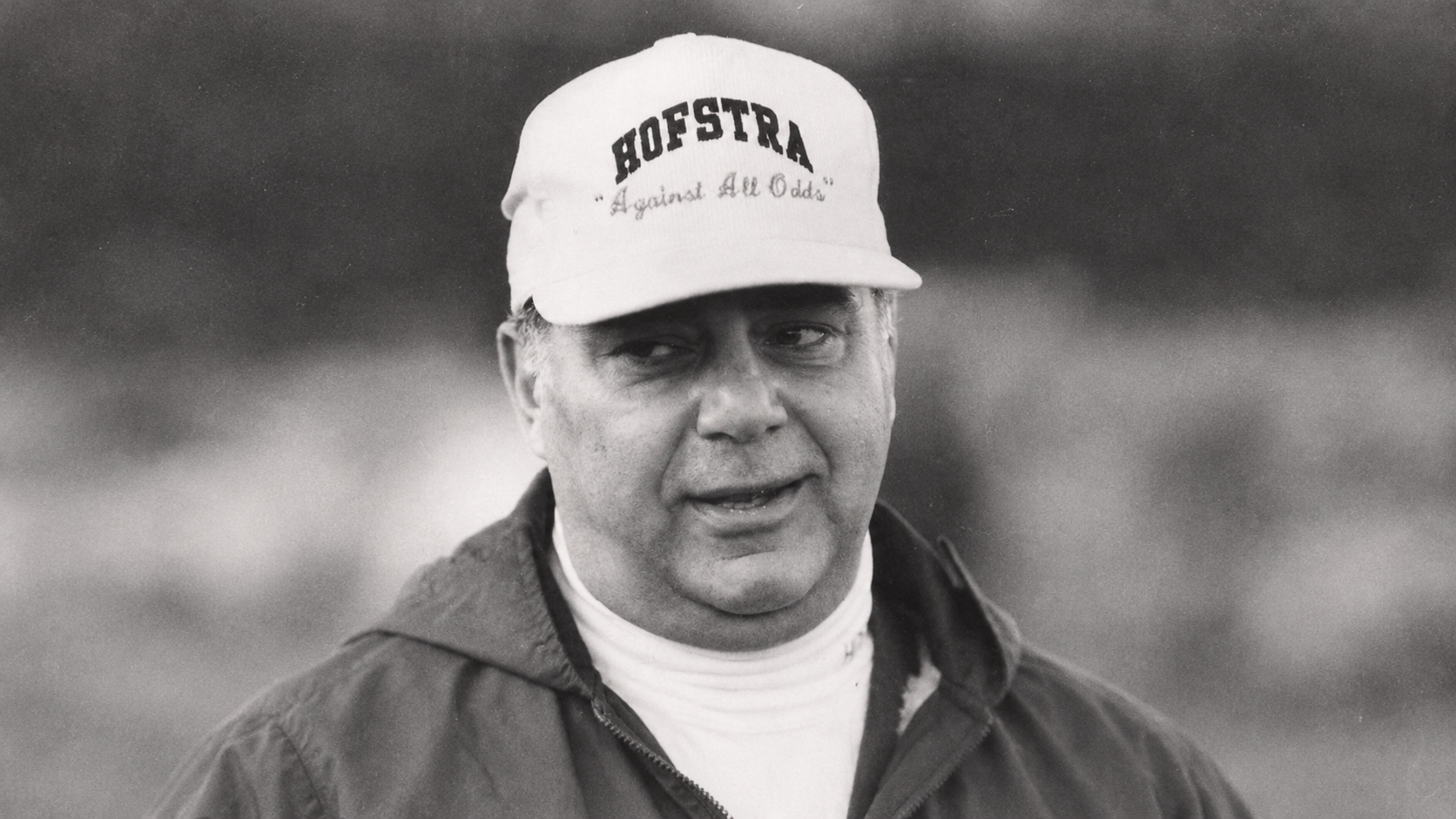
The dorm room at Hofstra had a bed, a desk and a party going on in the hallway. It was a Thursday night early in 1991, as I remember it. I had flown in from Manhattan, Kansas, that day on a ticket I'd paid for myself, about fifteen hundred dollars on short notice, which was a lot of money for me. At the foot of the bed was a suitcase full of VHS tapes. In my head I had about eight hours of material on the run-and-shoot offense, ready to go.
The head coach who had agreed to see me already had somebody else in mind. He'd told me so on the phone. The other candidate was staying across Hempstead Turnpike at the Marriott, and I found out later that the university was planning to introduce him the next day.
I knew I was the long shot. I went anyway.
The next morning I stood in front of Joe Gardi's entire staff. Offensive coaches, defensive coaches, everybody, in one big room with desks all over the place, because that's how the office was set up back then. I handed out an outline, got on the whiteboard and started explaining how I would install the offense. About ninety minutes in, Joe stopped me. He called a break and asked me to come see him in his office.
I remember thinking, we're just getting started.
I sat down, and within a couple of minutes he told me I had the job. Then he said he had to go call the fellow at the Marriott.
That's how I came to work for the man who taught me more about running a coaching staff than anyone I've worked for. When I wrote about the program he built in What Hofstra Closed, I said Joe deserved his own telling. This is it. It comes from my three seasons on his staff, which I talked through in Notebook 006, and from the public record of a career most football fans never saw whole.
The plan in the drawer
Joe came from Harrison, New Jersey, just across the Passaic River from Newark. He was a first-team all-state guard at Harrison High in 1955. He went on to Maryland, where he played offensive tackle and linebacker, was a co-captain in 1959 and won the Terrapins' Unsung Hero Award. He signed with Washington, played in two preseason games in 1960 and had a tryout with Buffalo in 1961. Then he went to work where most coaches start, in high school.
In 1964 he took over Oratory Prep in Summit, a program that had lost 37 games in a row before he arrived. His first team went 0–9. His second went 6–3. Then he moved to Roselle Park, a school that hadn't had a winning season in ten years. He went 2–7 the first year, then 6–3, and then 9–0 with a state championship in 1969.
I want to stop there for a moment, because those two jobs tell you who Joe was long before anybody in the NFL knew his name. Twice he walked into a program that had forgotten how to win. Twice he lost his first year. Twice he kept going until it turned. An 0–9 season didn't scare him off.
In 1970 he went back to Maryland to coach the freshmen and recruit. In his first year working the Long Island and New York area, he signed five All-Long Island players. He moved up to coach the varsity offensive line, and when Jerry Claiborne took over in 1972, Claiborne kept him to coach the receivers.
In 1974 he left for the World Football League, coaching running backs and special teams for the Philadelphia Bell. Before the 1975 opener he was made interim head coach, and the Bell beat the Portland Thunder, 31–30. He moved to the front office after that game. Two months later he was named Portland's head coach, and he went 2–1 before the league folded underneath him.
Hugh Wyatt, who coached with Joe on the Bell staff, met him in 1974. He later wrote that Joe already had his plan ready. "He knew everything he would do," Wyatt wrote, "had it all written down — when he became a head coach." Four games as a head coach, in a league that ran out of money. Then the plan went back in the drawer for fifteen years.
The Sack Exchange
Lou Holtz brought Joe to the Jets in 1976 to coach special teams and tight ends. Holtz didn't last the season. Joe stayed. Under Walt Michaels he coached special teams and linebackers from 1977 through 1980 and then became defensive coordinator.
In 1981, his first year running the defense, the Jets allowed 304 yards a game, the best in the AFC, and led the NFL with 66 sacks. That was the New York Sack Exchange: Mark Gastineau, Joe Klecko, Marty Lyons and Abdul Salaam. The next year, in the strike-shortened season, the Jets reached the AFC Championship Game and lost at Miami, 14–0, after holding the Dolphins to 197 yards.
I'm careful about how I say this. Great defenses have a lot of fathers, and those players were extraordinary on their own. But Joe was in the middle of it. When I got to Hofstra, I had never been around a coach who had done that at that level and then chosen to coach college kids.
In 1983 Joe Walton, the Jets' offensive coordinator, became head coach. According to George Vecsey of The New York Times, Walton agreed to take the job only if his friend Joe Gardi was named assistant head coach. They lived a few miles apart and rode to Hempstead together. "Sharing the burden is rare in football," Vecsey wrote. "Coach is always Coach."
It didn't last. The Jets went 7–9 in 1983 and 7–9 again in 1984. The Times reported that the two men had disagreed often about the defense, and that Walton wanted it more aggressive. On December 28, 1984, the Jets announced that Joe had resigned by mutual consent. The Los Angeles Times reported that Joe had volunteered that maybe he ought to leave, and that his car-pool partner didn't try to talk him out of it.
I don't know how Joe talked about that winter in private, and I won't guess. But keep it in mind, because it matters later in this story. His last job in the NFL ended in a disagreement with his head coach about how to run his side of the ball.
Five years in stripes
From 1985 to 1990, Joe worked in the NFL office as an assistant supervisor of officials. His job was evaluating, recruiting and training college officials for the professional game. The department was run by Art McNally, the man ESPN would later call the father of modern officiating. Joe's knowledge of officiating stayed with him. In 2003, while he was still coaching at Hofstra, he was named to the NCAA Rules Committee.
He never got coaching out of his system, though. Wyatt wrote that Joe told him he missed being called "Coach."
Here's my own read, and I offer it only as that. Five years spent teaching men to see a play correctly, at full speed, from one angle, with no second look, is teaching. It's careful, patient, detailed teaching of grown men who are already good at what they do. I believe that's part of why Joe heard what he heard in that interview room.
Across the turnpike
In 1990 Joe took the head job at Hofstra. His new office was in the field house on the south side of campus. Weeb Ewbank Hall, where he'd been the Jets' assistant head coach, was across the eight lanes of Hempstead Turnpike. Vecsey put the distance at about three touchdowns.
Joe said his daughter had asked whether he thought about it every time he passed the Jets' building. "But actually, I don't pass it," he said. "I come the other way."
"I just wanted to be called Coach again," he told Vecsey. "I want to control my own destiny." He literally kissed the artificial turf before his first practice.
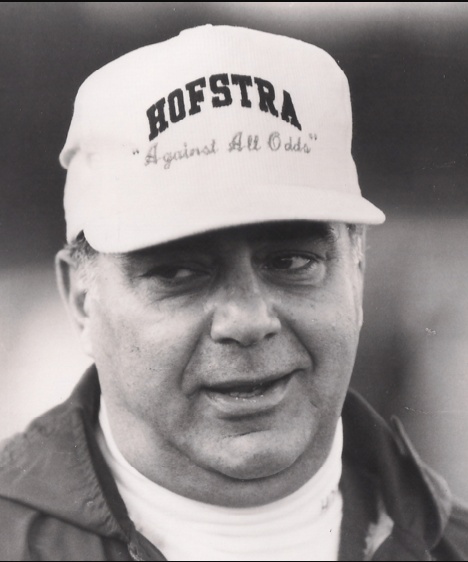
He gave that team a motto, "Against all odds," and wore it stitched across the front of his Hofstra cap. He told the players' families, "The fourth quarter belongs to us." It's fair to say the odds weren't all that long. Mickey Kwiatkowski had left him an 8–2 team with fourteen starters coming back, and Mark Cox, a running back on that team, said later that Mickey's talent made it easier for Joe to come in and put his system in. But Hofstra had lost all five of its postseason games before then. Joe's first team went 10–0 in the regular season, beat Cortland State, 35–9, for the school's first playoff win, and reached the Division III national semifinals. Rob Spence ran that offense, and ran it well.
Then Holy Cross hired Rob, and Hofstra needed an offensive coordinator. My friend and mentor Ben Griffith, who had taught me so much of the run-and-shoot, was friends with Mouse Davis. Mouse didn't know me. He called Joe anyway, on Ben's word. That call put me on the phone with Joe, and the phone call put me in that dorm room.
Teacher first
When he hired me, Joe told me what he'd liked. It wasn't just that I knew the plays. He liked the way I taught them: the organization, getting on the board, explaining a concept so the people listening felt like they were inside the play.
I had a degree in biology. I had taught and coached in high school. What I remember him telling me was, you're a teacher first, and that's what our guys need as we move up and play at a higher level.
Think about who was saying that. Joe had run the defense for the Sack Exchange. He'd spent five years training officials for the NFL. He could have hired a coordinator who sounded like a pro coach. He hired the one who could teach.
He then made a habit of saying the same thing about himself. When he announced his retirement in 2005, he said he was proud of being "a teacher and mentor." He said he'd taught his players "life skills which they could use beyond the football field," and that parents had thanked him "for watching over their sons."
The open door
Joe's door was open. You could walk in, get on his whiteboard and work through an idea with him, and he never made you feel like a young coordinator who should have known better.
He wanted his offensive and defensive coaches working together, and Greg Gigantino and I did. If I had an idea, I wanted to know how Greg and his staff would attack it. That wasn't giving away secrets. We were on the same staff. Those relationships outlasted the job. Greg still calls me now and then to talk through something an offense is doing to him.
When Joe needed to correct you, it was a conversation. What I remember him saying went something like this: let me tell you what I see, you think about it on your end, and let's come to an agreement about how we move forward. There was no emotion attached to it. He would tell you a story to make you see the thing a different way, and then he'd let you make up your own mind.
He had sayings. "Don't tell me how rocky the seas are," he'd say. "Just bring in the ship." He talked to us about Don Quixote and the windmills. His point was about attention: know what matters, and don't let the things that don't pull you away from the work.
He was the same with players. I remember him handling problems one-on-one, in his office, never by making an example of a young man on the practice field. He understood that they weren't all the same, and he never left one of them out on an island in front of his teammates. I believe that's a big part of why they trusted him.
I can honestly say Hofstra was the least stressful place I ever worked in coaching. That doesn't mean we didn't care about winning. Coaching is stressful enough. An assistant carries whatever stress the head coach brings into the building, and Joe didn't bring it.
On game day he was poised. Greg ran the defense, I ran the offense, and Joe ran the special teams himself, with help from the rest of us. He didn't get too high or too low. He was focused, and he was always coaching, coaching the coaches as much as the players, and keeping the energy up on the sideline from the opening kickoff to the last snap. That's what poise looks like on a sideline. In some ways he was almost Saban-like: calm on the outside, locked in on the next play, never letting the moment run the staff.
Hugh Wyatt caught another side of that when he spent two days with Joe before a game at Portland State in 2000. They were leaning on the goal post during warm-ups when Joe told him, "I've never been able to figure out whether they're ready to play." He was more than a decade into the Hofstra job and still honest about what he didn't know.
It better work
There was one time Joe and I really disagreed.
Moving up a level meant nights like November 14, 1992, when we flew to Missoula and Montana beat us, 50–6. We had thrown the ball for more than 400 yards a game the year before. But going into my third season, we had a younger offensive line, a good back in Hayward Cromartie and a quarterback, George Beisel, who I thought could run the option. I'd become interested in the triple-option ideas Ben Griffith had shown me, and I wanted to put in the veer. If we could make people account for that running game, I thought it would help everything we were doing throwing the ball.
Joe wasn't comfortable with it. He wanted us to look more like a pro team, and no pro team ran anything like that. I also remember him talking about the possibility of getting back to the NFL, or of a job at a place like Maryland. In his mind, that offense didn't fit where he might go next. I'm not saying he had an offer. I'm telling you what I remember us discussing, and I don't think there was anything selfish in it.
We went back and forth. In the end, what I remember him saying was, "You can do it, but it better work."
I want to be clear about this. I didn't sneak the veer into the offense. He knew exactly what I wanted to do. He didn't like it, and he gave me permission anyway, and then he left the offense in my hands. Joe never called a play for me in the three years I was there.
The way we ran it wasn't the textbook veer. We ran it out of one back, and we didn't have a pitchman. To the trips side of the field we were running our run-and-shoot passing scheme. George would ride Hayward on the dive, and if he pulled the ball, he could throw it. Today people would call that an RPO. In 1993 nobody had a name for it. We were just trying to make a defense wrong every snap.
The night I remember best is October 30, 1993, at home against Towson State. Towson came in with one loss and a habit of burying people early. The Baltimore Sun reported that the Tigers had outscored their opponents 77–7 in first quarters. After that night, they didn't lose again all year.
It was a steady downpour, with gusting wind and a slick turf field. Only 897 people came out for it. Standing on our sideline, I couldn't see Towson's coaches on the other side of the field. My memory says nobody could throw the ball that night. The record says George threw three touchdown passes: a 72-yarder to Ken Colon and two to Wayne Chrebet. That was the whole idea of the play. Teams that loaded up to stop the run left the passing game open.
All three of Hayward's touchdowns came on the same play, the veer. On our first snap, Towson blitzed both safeties. We veer-blocked it, the tackle came down, and the hole was enormous. George rode Hayward, gave him the ball, and he went 43 yards untouched. Later in the first quarter, same play, he scored from 2 yards out. On our first snap of the second quarter, same play again, he went 44 yards. He finished with 111 yards on 13 carries and three touchdowns. Add George's three touchdown passes, and that night showed exactly what we'd hoped the offense could be: a team that could run it and throw it, in a downpour, against a good opponent.
The other half of that night belonged to Greg Gigantino. Towson came to Long Island averaging 461.3 yards a game, and over the season it averaged 38.1 points. Its tailback, Tony Vinson, led the nation in rushing that year with 2,016 yards, setting a Division I-AA record. A year earlier he had run for 256 yards against us. Greg's defense held him to 127 yards on 34 carries, and held Towson to 12 points. When Towson fumbled a punt, Al-Vaughn Brown recovered it, and we went 57 yards for a touchdown. Our offense put up those numbers because Greg kept giving us the ball back. He was a master at it, that night and every night I coached with him.
We won, 40–12.
We went 6–3–1 that season, Hofstra's first as a full Division I program. I thought the addition helped us win games. Did Joe ever really like it? I don't know. My feeling was that he never fully got comfortable with it.
Now think back to 1984. Joe had been on the other side of that conversation. He'd been a coordinator whose head coach didn't like the way his side of the ball was being run, and it had cost him his job. I can't tell you whether he had that winter in mind when I walked into his office talking about the veer. But I know how he handled it. He told me what he thought, he told me the price, and then he got out of the way.
"You can do it, but it better work" sounds like a warning. It's really two things in one sentence: permission and accountability. You get the freedom, and the bill comes with it. It's easy to give an assistant freedom when he's doing exactly what you'd do. It's a lot harder when he's asking you to trust a decision you wouldn't make. I didn't fully appreciate that until I was a head coach myself.
You have to go
After that season, Bill Snyder asked me to come back to Kansas State. They had just played in the Copper Bowl, the program's first bowl game under Bill, and Nick Quartaro was leaving to become the head coach at Fordham. Bill offered me the job.
I turned it down.
I wanted to stay at Hofstra. I believed we could build something there nobody expected. We were recruiting nationally. I had signed players from Florida, Texas and Ohio. I looked at our coaches, the players we could get and where we were located, and I didn't see why, with a few more years and more scholarships, we couldn't play with Syracuse and Rutgers, and maybe beat them.
That was my dream, not a plan Joe ever stated. His expertise and optimism helped me believe it, but I don't want to put my ambition in his mouth. I wanted to be the dragon slayer, the Beast of the East. I wanted to help do something that hadn't been done there before.
Years later, though, I read something Joe said, and it made me smile. When Hofstra ended football in December 2009, he told the sportswriter Jerry Beach that for a lot of years, Hofstra had sent more kids to the pros than a program like Rutgers. "And we would have loved to have played those teams," he said.
The coaching grapevine being what it is, Joe found out I'd turned Bill down. He brought me into his office. What I remember him saying was, you don't have a choice, you have to go. He told me he would never hold a coach on his staff back from an opportunity like that. He wanted me to call Coach Snyder back and tell him I wanted the job. Then Joe called Bill himself.
Within a week I was at the national coaches' convention as a Kansas State coach. I had to leave Long Island.
That's a pretty good mentor. He'd brought me in, given me an offense to run and let me make my own mistakes. And when he thought it was time for me to take the next step, he pushed me out the door, even though I wanted to stay.
I wasn't the only one. Raheem Morris played in Joe's secondary from 1994 through 1997. "He was as close to me as anyone I've ever recruited," Joe told the New York Daily News. "I had a special feeling about him." Joe hired him as a graduate assistant in 1998. Raheem went to Cornell, then came back in 2000 to coach the defensive backs. One morning Herm Edwards, then the Jets' head coach, was walking through the Jets' practice bubble on campus. Joe flagged him down and told him to watch Raheem. Edwards offered him a summer internship with the Jets, and that led to Tampa Bay. By 2009, Raheem was the Buccaneers' head coach. "That was the luckiest thing that could have ever happened to me," Raheem said of the day Joe stopped Herm Edwards.
Dan Quinn coached Hofstra's defensive line in the late 1990s. Years later, asked about the coaches who shaped him, he started with Joe. "What a great mentor," Quinn said, "for all the young guys who were a part of his staff." When Joe died, Hofstra listed former assistants of his then working in professional football, including Morris, Quinn, Joe Woods, Chip Garber and Jaime Elizondo.
Joe didn't make those careers. The men who had them did. But he did something a lot of head coaches won't. He treated a good assistant's next job as part of his job.
Peter Luger and a sausage pie
It wasn't all football with Joe. He was fun to be around.
On the road recruiting, or on a free night, he'd call and say, let's go to this place. He loved a good Italian restaurant. He'd tell you where to get the best pizza, in New Haven or in Jersey, as if it were something you needed to know. One night he took me to Peter Luger with a friend of his who supported the program. I'd never had an experience like that. He was comfortable bringing his young coaches around the people who backed Hofstra, and he made you feel included.
He lived out in Sayville, in Suffolk County, a long drive to Hempstead every day. The legend, which Joe told himself, was that his wife, Audrey, would have dinner ready when he got home, and that he'd stop at the local pizza shop on the way, buy a large sausage pie and eat it in the car. Then he'd go home and have dinner. He was a big man.
I was at his house a couple of times and met Audrey. He was good with our families, too.
His son, David, was around the program then, finishing high school and deciding where he'd go to college. I don't want to make it sound like David and I were close. We weren't. I was one of his dad's coaches, and we'd have an occasional conversation. But I remember how bright he was and how proud Joe was of him. David played quarterback at Brown, earned his law degree at Hofstra and spent twenty-one years in the NFL's league office. This past May, the Tennessee Titans named him their executive vice president of football operations.
When Joe retired, he said something about family that I've never forgotten. "When I was coaching for the Jets," he said, "I missed out on a lot of opportunities to watch my children grow up." He wanted to be there for his grandchildren. That pride in David I saw in the 1990s was, I think, a man making up for lost time.
The letter
Years after I left, I was coaching at Texas Tech. Somehow I was still on a Hofstra football mailing list, and the program was raising money for something. I wrote a check and put it in the mail.
Then a letter came back from Joe. It was long and it was heartfelt. He told me how proud he was, and that he'd been following what I was doing: Emporia State, then Wyoming, then Texas Tech. He knew where I had been and what I was working on.
I'm paraphrasing. I won't pretend I remember every word. But I remember how it felt. I wasn't on his staff anymore. I wasn't helping him win games. And he was still paying attention.
Later, recruiting on Long Island, I came back through Hempstead and sat in his office again. We talked for a while. It was good to see him there.
Never out of coaching
Joe retired after the 2005 season, a 7–4 year with wins over Massachusetts and Delaware, both nationally ranked. His record was 119–62–2 over sixteen seasons. He had taken a non-scholarship Division III team into Division I-AA, to five I-AA playoff appearances, a Lambert Cup and a share of the Atlantic 10 title. Dozens of his former players came back to Hempstead for his last game.
Four years later the university ended football, and I've written about that day already. Joe told Jerry Beach he felt his legacy was gone. "And I thought it was a pretty good one," he said. Six months later, on June 2, 2010, he died at North Shore University Hospital in Manhasset after a stroke. He was 71.
Back in 2000, after watching Joe's team open the season by winning at Montana, 10–9, eight years after we'd lost there 50–6, Hugh Wyatt wrote a short lesson about him and called it a lesson in persistence. He ended it with one line: "If you are really a coach, you are never out of coaching."
That's the part I'd argue with Joe about, if I could have one more afternoon at his whiteboard. His legacy isn't gone. It isn't the stadium or the record book. It's in the coaching offices of the men who worked for him. It's in how they correct a young coach in private, and how they keep the door open. It's in how they let a coordinator run his side of the ball, and how they pick up the phone when the right job comes for somebody else on their staff. I've run staffs. I know where I learned to do it.
I was such a young coach when he hired me. I knew what I wanted to do with an offense. I'd studied it and I was passionate about it, but I had so much left to learn. Joe gave me the chance to make mistakes and grow. He let me walk into his office and argue a concept, and nothing was off-limits. He was generous with his time. I don't believe I could have become the coach I became without the lessons I learned on his staff.
I paid my own way to that interview because I wanted a chance to coach the run-and-shoot. I got that chance. I also got to work for Joe Gardi, and when I bought that ticket, I had no way of knowing that would be the bigger part of the deal.
So, Coach, thank you, for the opportunity, for the memories and for the room to grow.
It worked.