
The Letter
The usual way to become head coach of an NFL team has never included writing to the owner and telling him you're ready.
Mike Ditka did it anyway. During his years coaching for Tom Landry in Dallas, he sat down and wrote to George Halas. It was a long letter. He said he regretted how his time in Chicago had ended. He said that one day, when he was ready, he wanted to come home and coach the Bears.
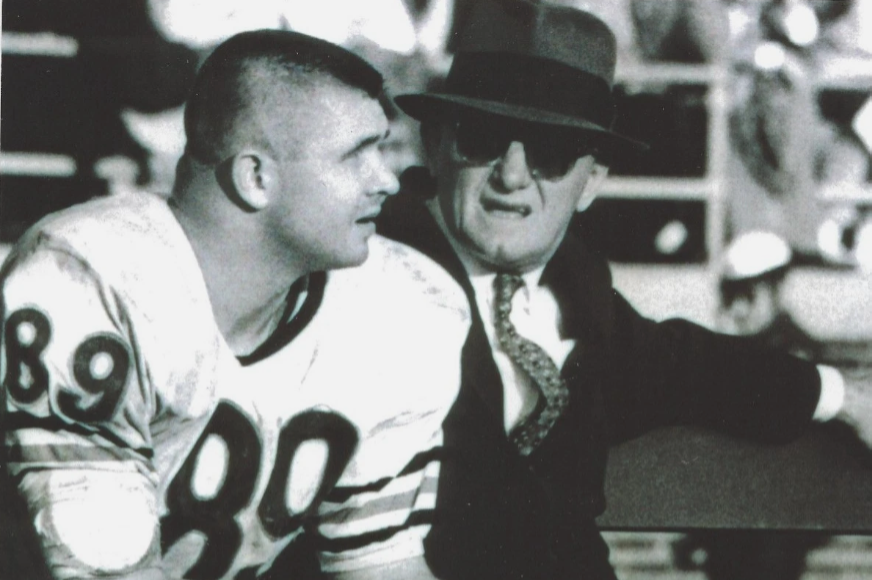
The man he was writing to had traded him away years before. Halas had founded the franchise and the league around it. He had played for the Bears, coached them, owned them and kept the books. In a contract fight, Ditka had told reporters that Halas "throws nickels around like manhole covers." Halas sent his All-Pro tight end to Philadelphia for a quarterback and a draft pick, and that seemed to be the end of it.
It wasn't. In January 1982 Halas was 86 and back in charge of football decisions. He fired Neill Armstrong. He kept Buddy Ryan's defensive staff, because his own players had written him a letter of their own asking him to. Then he turned to Dallas.
On Friday, Mike Ditka's family announced that he had died. He was 86, the same age Halas was when he hired him.
Not the Obvious Choice
Halas had safer options. George Allen, an established winner and a former Halas assistant, called him and made an hour-long pitch for the job. Ted Marchibroda was on the staff. Ryan was in the building. Ditka had never been a head coach at any level. Chicago remembered him as the hothead who once decked a fan in the Coliseum and left town insulting the boss.
Halas hired him anyway, and he didn't bother naming the other candidates. Ditka was introduced on January 20, 1982, at the team's offices at 55 East Jackson. Halas explained the choice in one sentence: "I like his ability to manage himself and others."
Look at who was speaking. Halas had managed himself and others for six decades, as a player, coach, owner and league founder. He was not hiring a coordinator with a system or a candidate with a résumé. He was hiring someone he had already coached, already fought and already forgiven. He was choosing a successor.
Ditka had said it more bluntly the night before. He would report "only to George Halas. I have to be in control. I know where the buck stops."
That is not how head coaches talk about their jobs today. It is how Halas talked about his.
What Halas Saw
I've spent my working life around head coaches. In my experience, the ones who last aren't the ones with the best playbooks. They're the ones whose teams look like them. You can watch a team for a quarter and tell who coaches it.
The Bears Halas built looked like Halas. They were hard, physical and suspicious of anything fancy. The franchise didn't spend money it didn't need to. Players were loyal because the man in charge was loyal, and they knew the same man could cut them loose. When Halas drafted Ditka out of Pitt with the fifth pick in 1961, he described exactly the player he wanted: "rugged enough to take those important first-down passes over the line in heavy traffic," and "strong enough to clear the way for our backs." Halas wasn't picking an athlete. He was picking a temperament.
Ditka was Rookie of the Year that season. Two years later he was a big part of the 1963 championship team, Halas's last title as head coach. He made five straight Pro Bowls. He played tight end with a violence the position hadn't really seen before, which is why he became the first tight end in the Pro Football Hall of Fame.
The fight between them was real, and so was the bond. Halas warned him about his carousing. Ditka mocked the old man's stinginess. They were like a father and son: close, angry and unable to stay apart.
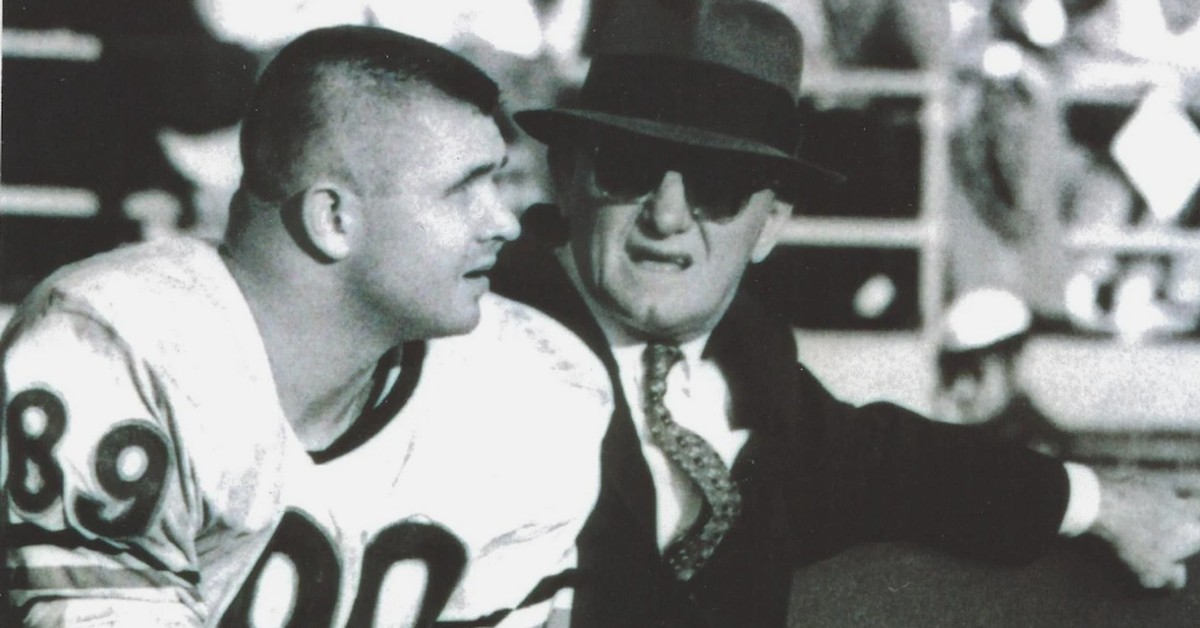
Then Ditka spent nine years learning under Landry, the coolest and most methodical coach of his era. Landry showed him how a modern operation worked: the organization, the preparation and the structure. What Landry couldn't do was change who Ditka was. So when Halas called, Chicago got Landry's methods carried out with Halas's temper.
The Old Man's Football
Ditka's first meeting with the players followed a speech Halas could have given. Stay with me, he told them, and in three years we'll be in the dance.
He also inherited the defensive coordinator Halas had insisted he keep. Early on, Ditka told Ryan he wanted to install Dallas's Flex defense. Ryan's answer, as Gary Fencik later recalled it, was that Ditka was the head guy and could do whatever he wanted, but Ryan would not be around to run it. Ditka backed off.
A lot has been written about the feud between Ditka and Ryan, and most of it treats the tension as a flaw. I think Halas understood it as the point. He gave his young coach control of the team, but not complete control of the staff, and put two strong-willed men in one building. Halas had spent his life running a franchise on that kind of pressure, and he knew what it could produce.
He didn't live to see it. George Halas died on October 31, 1983, in the middle of Ditka's second season. The Bears wore a patch with his initials for the rest of the year. The next season they stitched GSH onto the left sleeve of every jersey, where it still is today.
So in January 1986, when the Bears beat New England 46–10 in the Super Bowl, they were wearing the initials of the man who had traded their coach, forgiven him and hired him. The 1985 Bears were the toughest and most physical team the league had seen in years. Their swagger was their coach's. Their defense was Ryan's. The idea of the team, a hard team from a hard city run by one hard man, went back to Halas.
Fresh Ideas
On January 5, 1993, Michael McCaskey, Halas's grandson and the Bears' president, fired Ditka after a 5–11 season. The team, he said, would put "a premium on fresh ideas and new strategies."
It was a reasonable decision. The roster had aged and the results had slipped. But the wording says more than the decision does. "Fresh ideas and new strategies" is the language of a modern front office. A founder doesn't talk that way. Halas hired his last coach by reading a letter and trusting what he knew about a man. His grandson let that coach go with a statement about process.
Ditka's response was very much his own. "I'm a Bear," he said. "I've always been a Bear and I'll always be a Bear, no matter what anybody says."
He coached the Saints for three seasons later in the decade, and it didn't go well. That doesn't take away from what he did in Chicago. If anything, it confirms it. His way of coaching only worked inside the place built by the man who formed him.
No One Gets Hired That Way Now
Every NFL head coach today comes through a process. There are search firms, interview requirements, presentations to ownership groups and analytics departments. Some of that is real progress, and the league is better for it.
But something was lost, and Ditka's career shows what it was. The founder who built the franchise chose the last coach of his life the way you'd choose a son-in-law: on character, on history and on a fight both of them had survived. Halas made no more coaching hires after Ditka. The line that started with him in 1920 ended with the tight end he once traded for a quarterback.
Ditka spent the rest of his life acting as if he knew that. He spoke up loudly for retired players whose bodies had paid for the game. He kept coming back to Chicago, and last month he was home there again, after the heart attack, the strokes and three hip replacements. In 2013 the Bears retired his No. 89, and he is still the last Bear to have his number retired.
Chicago has now lost two men from that 1985 team in five weeks. Matt Suhey, the fullback who blocked for Walter Payton and scored the first touchdown of Super Bowl XX, died on September 6 at 68. Now his coach is gone too.
On Sunday the Bears play in Green Bay, in the oldest rivalry the game has. Halas and Curly Lambeau started it a century ago, when one man could found a team, play for it, coach it and own it. When the Bears take the field, there will be three letters on every left sleeve.
Mike Ditka spent his whole football life trying to earn them.
Mike Ditka, 1939–2026.